Double Lunging – Exercises, Attachment, Tips for Beginners & Advanced Riders
Double lunging is much more than lunging with two lines: It enables gymnastic work, targeted aids, and effective muscle development — all without the rider’s weight. In this practical guide, you will learn how to properly set up the double lunge, what equipment you need, when a roller is useful, and how to help your horse work on flexion, bend, and balance with simple exercises.
Table of Contents
What does double lunging do for the horse?
Double lunging is a true all-rounder in horse training. It combines the benefits of lunging with those of classical groundwork and allows you to give finely tuned aids — all without rider weight. It is ideal for:
- activating the back,
- improving contact,
- promoting suppleness and collection,
- or specifically working on flexion and bend.
Especially for young horses, rehab horses, or horses in muscle building, double lunging offers a gentle yet effective training option.
Even higher movements such as shoulder-in, travers, or even piaffe can be prepared on the double lunge — with fine aids and precise communication.
Is double lunging an alternative to riding?
Double lunging does not replace riding, but it can complement it very effectively in many situations — for example:
- in the development phase of young horses,
- during riding breaks or after injuries,
- when certain movements are to be prepared specifically from the ground.
The big advantage: you work in a rider-like manner but without burdening the horse with weight. This allows you to promote collection, flexion, and back activity — with precise control and better overview.
Double lunge vs. long reins — what is the difference?
Both methods use two lines from the ground — but they differ clearly in purpose, handler position, and influence.
What do I need for double lunging?
Having the right equipment is essential to ensure that your horse can work safely, calmly, and effectively on the double lunge.
1. Double lunge
The classic double lunge consists of two lines (approx. 16–20 m), often connected with a snap or buckle. Biothane is low-maintenance, grippy, and durable. For beginners, cotton or nylon is softer and often more comfortable in the hand. For more advanced use, a multifunctional double lunge with several attachment points is suitable.
2. Lunging surcingle
A well-padded surcingle with several rings at different heights is essential. Depending on the ring position, you can influence bend, elevation, or engagement of the hindquarters.
3. Cavesson or bridle?
4. Lunging whip & gloves
The whip serves as an extended arm. It should be light but sufficiently long. Gloves protect your hands and provide better grip.
5. Optional: roller
With a roller, you can guide the outside line particularly smoothly. It reduces friction, increases control, and is ideal for young or sensitive horses.
Double lunging for beginners
The thought of double lunging initially causes many people to feel some respect: two lines, several attachment options, and a horse that may never have worked with such equipment before. But don’t worry: if you proceed systematically, you will quickly notice how much potential this training method offers. Here you get a simple, practical introduction — perfect for getting started.
Why double lunging at all?
Double lunging is like a bridge between groundwork and riding. You can use it to:
- gymnasticize your horse and strengthen the back muscles,
- improve flexion and bend,
- work on transitions, rhythm, and balance,
- prepare for riding or collected movements.
Unlike single-line lunging, you have influence from both sides — meaning you can guide your horse precisely, ask for flexion, and take contact on both reins. This makes the work much more differentiated and therefore more effective.
The correct setup: step by step
Step 1: Getting used to the equipment
Before you begin, let your horse get to know the double lunge calmly. Lay the lines loosely over the back, lead the horse for a few rounds with the lines threaded through — without pressure, simply to introduce the sensation. This gives your horse a first feeling for the lines on the body.
Step 2: Attaching the double lunge
For beginners, the following attachment is recommended:
- Inside line: attach directly to the cavesson.
- Outside line: thread through the lower rings of the surcingle and also attach to the cavesson or bit.
This setup allows good lateral influence without blocking your horse. More on this in the next section.
Step 4: Your position
Do not stand directly behind your horse, but slightly to the side — roughly at shoulder height with sufficient distance. This allows you to see the horse, give clear aids, and stay out of the “line of fire.”
Step 5: The first steps
Start at the walk on a large circle. Pay attention to:
- keeping the lines neither hanging loose nor tight,
- guiding the outside line smoothly — it lies softly but ready in your hand,
- motivating your horse calmly with your voice and the whip if needed.
Only when you feel confident should you move into the trot. Canter is often too much for beginners — wait until you feel more coordinated.
When is your horse ready for double lunging?
In general, almost any horse can work with it — whether young, old, large, or small. Pay attention to:
- physical health (e.g., no acute lameness),
- a basic level of obedience (stopping, moving off, responses to voice),
- a calm environment — this makes it easier for both of you to concentrate.
Attaching the double lunge
The correct attachment of the double lunge is crucial for effective and safe training. Especially for beginners, it is important to approach it slowly and understand how guiding the lines through the different rings of the surcingle changes the influence. An incorrect attachment can confuse your horse or even block it — which is why it is worth being especially careful here.
How do you attach a double lunge correctly?
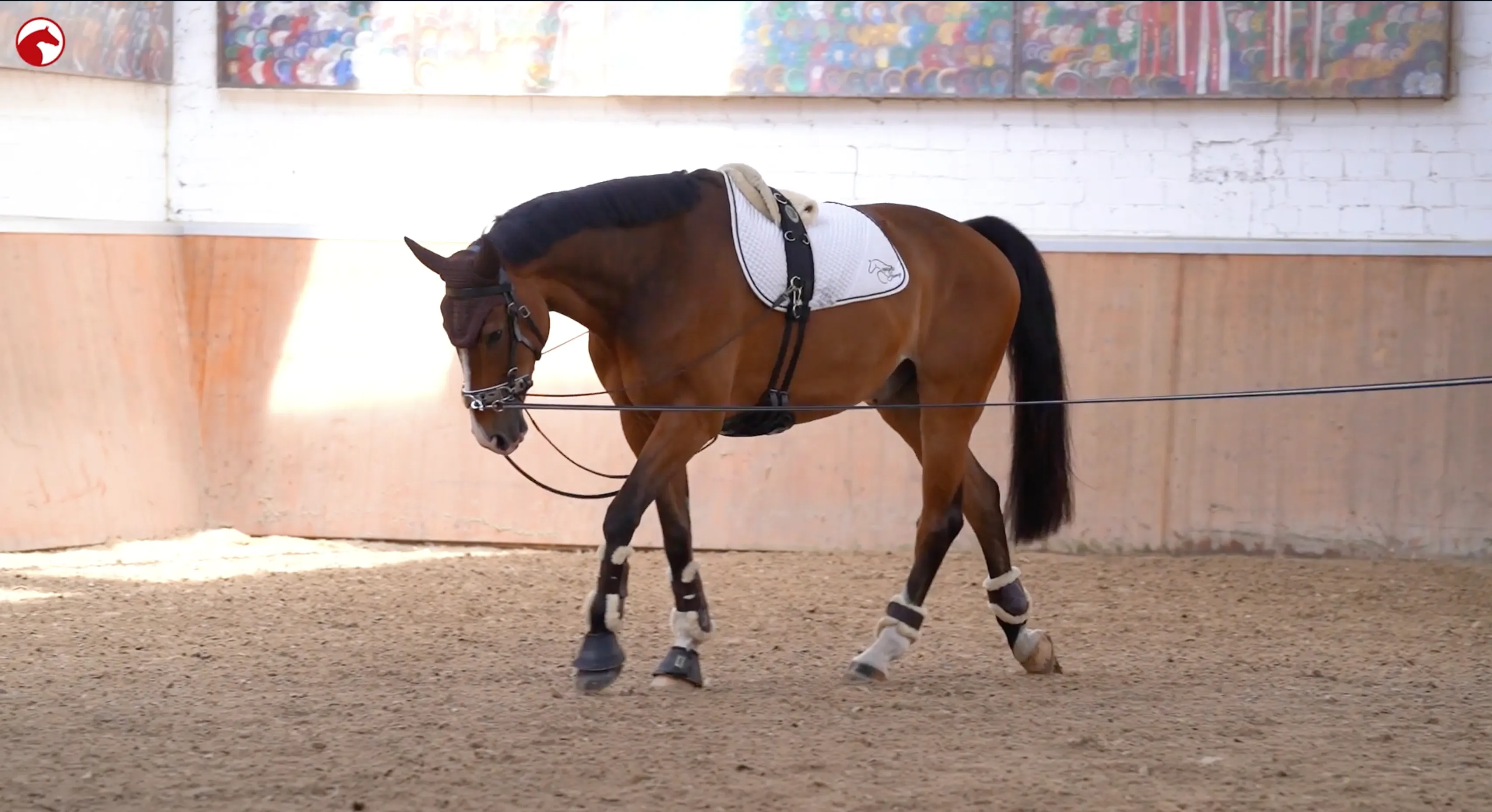
Basically, you have two lines: the inside line, which is on the side facing the center of the circle, and the outside line, which is guided around the horse. Both end at the cavesson or the bit — depending on what you use.
Standard attachment for beginners (recommended):
- Inside line: attach directly to the side ring of the cavesson.
- Outside line:
- from the outside handpiece
- through the lower side ring of the surcingle (at belly height)
- then to the opposite side ring on the cavesson (the outside of the horse’).
This attachment gives you good control over the shoulder and hindquarters without applying too much pressure to the mouth or poll.
Alternative attachments — depending on training goal:
-
Should I guide the double lunge over the back or behind the hindquarters?
Both variations are possible, but they have different effects:
- Over the back:The classic version. The outside line runs over the croup or back and gives the horse lateral guidance. Well suited for balance and flexion.
- Behind the hindquarters:For very experienced horses. The line runs behind the horse, which allows stronger influence on the hindquarters — but can also easily lead to misunderstandings.
For beginners, the clear recommendation is: guide it over the back. This keeps the influence gentle, controlled, and easy for the horse to understand.
How do you lunge correctly with the double lunge?
You position yourself slightly to the side of the horse, not behind it. Your body language and position influence tempo, direction, and contact:
- At shoulder height: driving influence
- Further forward: slowing, regulating
- Too far back: horse pushes strongly forward
Avoid constantly tight lines — work with short impulses, voice aids, and a steady hand.
Use clear voice cues to initiate transitions. Keep moving, check your position regularly, and give your horse time to get used to this new form of communication.
Double-lunge roller
Using a roller with the double lunge is common in classical training and with particularly sensitive horses — and for good reason. A roller allows you to guide the outside line smoothly over the surcingle without rubbing or catching on the horse. This can be a real advantage, especially for young or sensitive horses.
What is a roller in double lunging?
A roller is a small, rotating element that is attached to the surcingle — usually at mid-height on the side. The outside line is guided through the roller before it goes to the cavesson or bit. This creates a smoother line path with less friction and more direct signal transmission.
What are the advantages of a roller?
- Even line guidance — especially helpful for horses sensitive to uneven pressure
- Less friction on the surcingle — ideal for horses with sensitive skin or longer training sessions
- Better control over the outside shoulder, as the line does not catch or slip over the surcingle
Clearer aids for flexion and bend through a more consistent connection
Double-lunge exercises
Working with the double lunge offers countless possibilities to gymnasticize your horse in a meaningful way. From simple straight lines to curved figures and even preparation for collected movements such as the piaffe — with the right exercises you can specifically promote the back, balance, and suppleness.
Double lunging is particularly effective for muscle development, as it allows you to let the horse work over the back — without rider weight, but with finely dosed impulses from the outside.
Basic exercises for beginners
These simple exercises help you develop a feeling for handling the lines and teach your horse to work on the double lunge step by step:
1. Large circle at walk and trot
- Goal: balance, rhythm, contact
- Maintain even contact on both lines and use a calm, clear voice.
2. Figure-eight or change of circles
- Goal: improving bend and suppleness
- Change direction smoothly by softening the outside line and lightly taking the inside line.
3. Walk–trot–walk transitions
- Goal: response to voice, activation of the hindquarters
- Use voice and body language to ask for precise transitions.
Gymnastic work
- Serpentines and circles: promote bend and mobility of the spine.
- Halt exercises: train concentration and body tension — especially valuable before rein-back.
- Tempo changes within a gait: make the horse attentive and promote carrying power.
Targeted double-lunge exercises for the back
Especially for building back muscles, the double lunge is ideal because you can work your horse in a stretching frame — with gentle contact on both lines.
- Large curves with flexion:Let your horse trot on large lines with steady contact on both lines. This loosens and strengthens the back.
- Changing lines and serpentines:Promote coordination and core stability.
- Half-halts on the line:Activate the back and improve suppleness.
For advanced riders
- Rein-back on the double lunge → trains shoulder control and response to light impulses.
- Lateral work such as shoulder-in on the circle → promotes straightness and weight-bearing.
- Piaffe preparation → for experienced horse-handler pairs with clear communication — start small, praise often!
Piaffe on the double lunge
Piaffe on the double lunge is a high art — but also an achievable challenge when your horse can already work in collection. It is not suitable for beginners, but it is an exciting goal for advanced horse-handler pairs.
What you need:
- a well-prepared horse that already knows transitions, rein-back, and tension
- refined timing and a confident feel for body language and aids
- patience, praise, and clear breaks as a reward
Biothane, cotton, or multifunction double lunge?
Not every double lunge is the same. Depending on the material, handling, weight, ease of care, and even the influence on your horse differ. The terms Biothane double lunge, multifunction double lunge, and classic models made of cotton or nylon are especially common search terms. Here is an overview to help you find the variant that suits you:
Biothane double lunge
The Biothane double lunge is especially popular with professionals and frequent users. It is made of a lightweight, weatherproof synthetic material that feels comfortable in the hand and does not absorb moisture.
Cotton or nylon double lunge
These classic materials are especially suitable for beginners. They are soft, flexible, and comfortable to handle.
Multifunction double lunge
The so-called multifunction double lunge is a combination of a classic double lunge and long reins. It offers various snap and guiding points, sometimes with additional handles or stoppers.
Areas of use:
- especially flexible in training
- ideal for trainers or advanced riders who want to combine different working methods
Double lunge: The most important questions and answers
Why use rollers in double lunging?
Rollers ensure a smoother line flow, especially for the outside line. They allow precise influence, prevent rubbing on the surcingle, and provide a steady connection — especially for sensitive horses or more advanced attachment settings. They offer real advantages particularly with direct attachment to higher surcingle rings or during lateral work.
How long should a double lunge be?
The length of a double lunge is typically between 12 and 18 meters. For beginners, 14–16 m is often ideal. The longer the lunge, the more distance you have — helpful for larger horses or collected exercises, but more demanding in handling.
What does the double lunge do for the horse?
The double lunge helps you ask your horse for flexion, bend, straightness, and activation of the back — all without rider weight. It promotes suppleness, muscle development, concentration, and balance. Young horses also learn their first rein aids.
How do you hold the double lunge correctly?
You can hold the double lunge with one or both hands. For beginners, the two-handed method is recommended:
- inside line in one hand
- outside line together with the whip in the other
It is important that the lines are not tight but guided loosely and in a controlled way.
Which surcingle is suitable for double lunging?
A surcingle with several rings at different heights is essential. This allows you to guide the lines according to your training goal — low for more hindquarter engagement, high for more elevation. The surcingle should be well-padded and non-slip, ideally with a surcingle pad.
What is the double lunge used for?
With the double lunge you can work on flexion, bend, balance, and back activity — without rider weight. It is suitable for gymnastic work, the loosening phase, preparation for riding or driving, as well as corrective work for crooked or stiff horses.
How do you attach the double lunge?
There are several ways to attach it. For beginners, the so-called remonten attachment is recommended:
• inside line directly to the cavesson
• outside line through a surcingle ring, over the back, to the outside bit ring or cavesson ring
Experienced horse-handler pairs can also guide the line around the hindquarters — but only with a lot of practice and calmness.
Which bit for double lunging?
A simple loose-ring snaffle or a cavesson is ideal. For beginners, the cavesson is recommended because the hand influence does not act directly on the mouth. If you want to work more precisely or on higher movements, a soft-acting bit can be used — provided your horse is accustomed to it.
Is a cavesson or a bridle better for double lunging?
For beginners, a cavesson is better suited because you guide the horse via nose and poll — without acting directly in the mouth. A bridle is suitable for more advanced work or targeted dressage exercises, but requires quiet, finely dosed aids and a well-prepared horse.
What do I need for double-lunge work?
You need:
- a double lunge (cotton or Biothane)
- a well-padded surcingle with several rings
- a cavesson or a bridle
- a lunging whip
- riding gloves and sturdy footwear
- a safely enclosed lunging area or round pen
What is the difference between long reins and the double lunge?
With the double lunge, you stand at a greater distance slightly offset to the side of the horse. The lines run through the surcingle, and you work similar to riding — but from the ground.
With long reins, you work directly behind the horse. The reins run along the sides of the body to the head — similar to driving. Long-rein work requires more closeness, more control, and a lot of experience.
Should I guide the double lunge over the back or behind the hindquarters?
For beginners: over the back. This variant is easier, clearer for the horse, and less prone to problems.
Guiding it around the hindquarters increases influence on the hind legs, but should only be used by advanced horse-handler teams — ideally with a roller.
How do I accustom my horse to the double lunge?
First lead your horse at walk with the double lunge attached. Praise regularly and work with patience. Then begin on the circle with simple attachment and minimal pressure. Avoid sudden movements and give your horse time to get used to the new body sensation.
How do I hold a double lunge?
In the two-handed method, you hold the inside line in one hand and the outside line together with the whip in the other. Your arms form a rein-like connection — similar to riding. Advanced handlers also use the one-handed method, where the lines run between different fingers — but this requires practice and experience.
You might also like