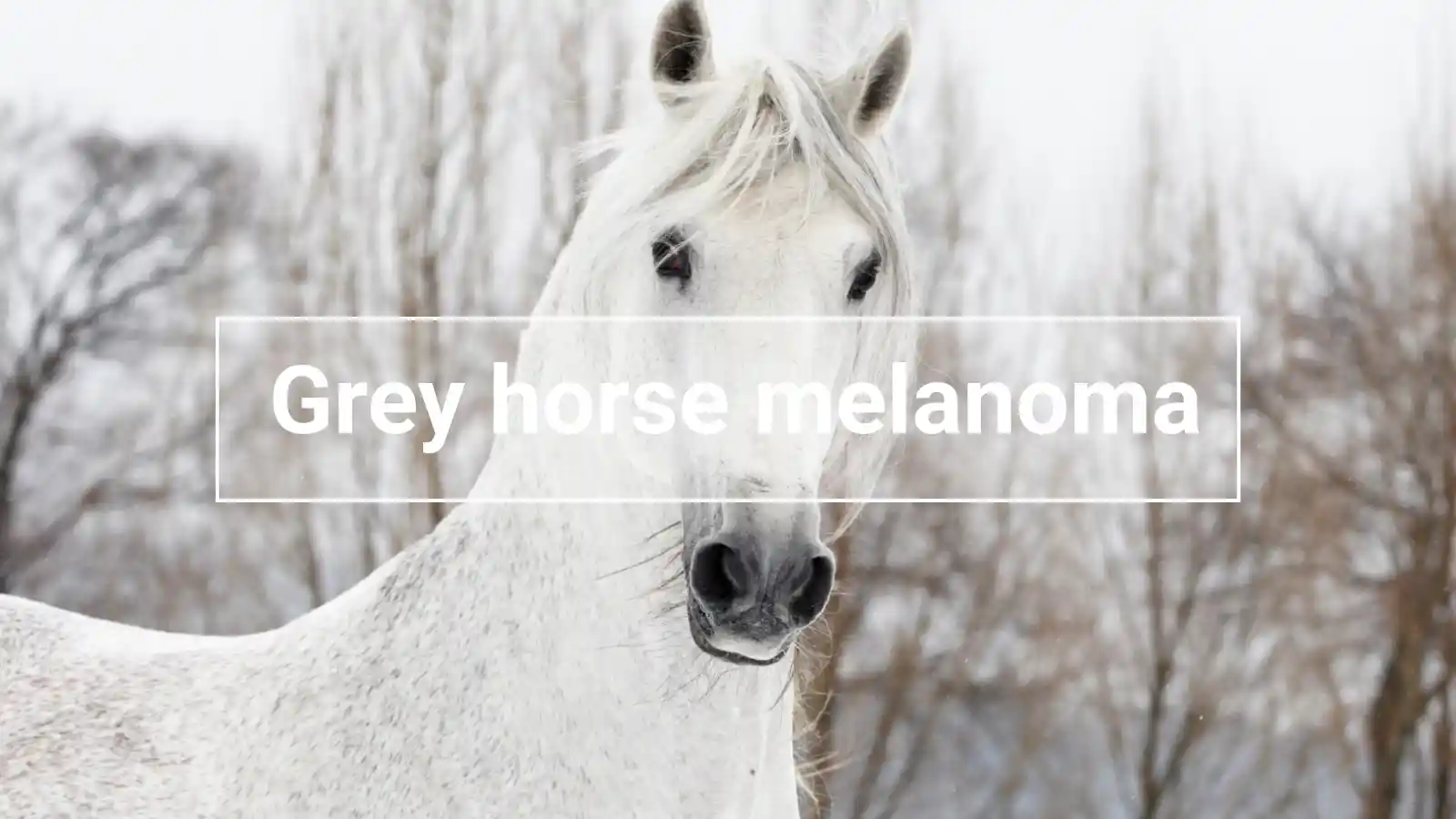
Grey horse melanoma – causes, symptoms, and treatment
Melanoma in horses is a widespread, mostly benign tumour that mainly affects older grey horses. In this article, you will learn how melanoma develops, which parts of the body are particularly at risk and what treatment options are available – from surgical removal to modern cream therapy and homeopathic approaches. It also explains how the life expectancy of affected horses develops and what owners should be aware of when dealing with the disease.
Table of Contents
What is a grey horse melanoma ? - Definition and explanation
A melanoma is a tumour of the pigment-forming cells (melanocytes) that occurs mainly in grey horses. These tumours are caused by an accumulation of melanin - the pigment that determines skin colour. In grey horses, pigment metabolism changes over the years, causing an increase in the accumulation of melanocytes and the formation of tumours.
Approximately 80% of all older grey horses develop one or more melanomas during their lifetime. These are usually benign, but can become malignant and spread to internal organs. Colloquially, the disease is therefore often referred to as ,,grey horse cancer".
Causes and development of grey horse melanoma
The exact cause is still not fully understood. The main factor is thought to be a genetic predisposition linked to the coat colour grey. In grey horses, a genetically determined mutation occurs in the STX17 gene as they age, which affects pigment metabolism.
This causes melanocytes to multiply uncontrollably, ultimately leading to tumour formation. Older horses are particularly affected, often from the age of 10 onwards.
Other possible risk factors include:
- UV-radiation (e.g. when grazing in summer)
- weakened immune system
- chronic inflammation or skin injuries
- hormonal changes in older animals
Typical locations and manifestations
Grey horse melanomas tend to develop in areas with thin skin and high pigment concentration. The following areas are particularly frequently affected:
- tail root
- anus
- mouth
- jowls,
- hose or udder region
- parotid gland
- neck
- eye and eyelid margin
Initially, they appear as small, hard, black nodules under the skin. As they progress, they can become larger, burst open or secrete black fluid. In some cases, several nodules form and merge into one another – this is referred to as melanomatosis.
If a melanoma has burst open, the horse should be examined by a vet as inflammation or secondary infections can develop.
Particularly susceptible horse breeds
Melanoma occurs almost exclusively in grey horses so in horses whose coat lightens with age. The underlying genetic defect in the STX17 gene is common across breeds, but some breeds carry it particularly frequently.
The most affected breeds are:
1. Lipizzaner
- The incidence is particularly high in Lipizzaners: Studies show that up to 90% of all older Lipizzaners develop melanomas.
- The cause is selective breeding for the grey colour – almost all Lipizzaners carry the ,,grey gene".
2. Arabian thoroughbreds and Arabian mixes
- Melanomas are also widespread in Arabians, especially in those aged 10 years and older.
- They tend to develop several small nodules, especially in the tail and anal areas.
3. Camargue horses
- This southern French breed consists almost exclusively of greys, so melanoma occurs frequently here.
4. Connemara ponies
- This breed also has an above-average incidence – presumably also due to the grey gene.
5. Andalusians and PRE (Pura Raza Española)
- These Spanish breeds are genetically closely related to Lipizzaners and are also often grey carriers. The risk is correspondingly high.
Less affected or resistant breeds
- Breeds without grey colouring (e.g. Friesians or Haflingers)show almost no cases of melanoma.
- Even in piebald horses, the risk depends exclusively on whether they carry the grey gene.
Conclusion on genetic predisposition
- The STX17 gene causes the typical ageing process of greys (from dark to light) and, at the same time, the overproduction of melanin, which can lead to tumour formation.
- The disease is therefore not linked to the breed itself, but to the grey gene – however, as some breeds carry this gene almost universally, they are statistically much more affected.
Symptoms: How can I recognise the grey horse melanoma ?
Grey horse melanomas often remain inconspicuous at first, as they grow slowly and have little effect on the horse. Typical symptoms include:
- lumps under the skin, usually dark in colour
- firm, sometimes rough thickening in the area of the tail root or anus
- changes in skin appearance (smooth, shiny, black)
- bleeding or weeping areas if the melanoma is open
- difficulty defecating or riding if the tumour is located in the anal area
- swelling of the chin or parotid gland, sometimes with difficulty swallowing
- fistula formation in advanced tumours.
If the tumour spreads internally (e.g. to the intestines, lungs or liver), non-specific symptoms such as weight loss, colic or breathing problems may also occur.
Diagnosis: How the vet recognises a grey horse melanoma
The clinical examination often provides clear indications. The vet palpates the lumps and assesses their size, consistency and location.
For a precise diagnosis, a fine needle aspiration or biopsy may be performed. This involves removing tissue and examining it histologically to determine the type and benignity of the tumour.
If internal involvement is suspected, ultrasound, X-ray or endoscopy may also be useful.
Treatment: What to do about melanoma in horses?
Treatment is always individual and depends on the size, location and progression of the tumours. Small, slow-growing melanomas can often be monitored initially. However, if they grow, cause discomfort or burst, targeted therapy should be initiated.
1. Surgical removal
Smaller clearly defined tumours can be easily removed surgically. The procedure is usually performed under sedation and local anaesthesia. Disadvantage: Recurrences may occur, i.e. new tumours in the same place.
2. Laser surgery
Modern CO₂ lasers enable precise removal of the tumour with minimal bleeding. This method is particularly suitable for sensitive areas such as the mouth, jaws or tail root.
3. Cryotherapy (freezing)
Here, the tumour tissue is frozen with liquid nitrogen, causing the cells to die. This method is often used in combination with surgical removal.
4. Immunotherapy and chemotherapy
There are various approaches to activating the immune system or inhibiting tumour growth with medication. For example, research is being conducted into vaccines that are designed to target melanoma cells.
5. Betulinic acid cream – a new therapeutic approach
A promising development is treatment with betulinic acid, a natural active ingredient found in birch bark. Betulinic acid cream can significantly slow down or even stop tumour growth in some horses. This treatment is currently being tested in several clinics and could offer a gentle alternative to surgery in the future.
6. Homeopathic support
Many horse owners also use homeopathy to support the organism. Frequently used remedies are Thuja occidentalis, Betulinum, Sulphur or Carcinosinum. Although homeopathy is no substitute for conventional medical treatment, it can strengthen the immune system and promote wound healing. Important: These remedies should only be used after consulting a veterinarian or animal health practitioner.
Nutrition and feeding for grey horse melanomas
A healthy diet can strengthen the immune system and thus have a positive effect on the course of the disease. The following are recommended:
- Good quality hay as the main feed
- Linseed oil or hemp oil to support cell health
- Antioxidants such as vitamin E, selenium and zinc
- Herbs with immune-boosting effects (e.g. echinacea, milk thistle, stinging nettle)
You should avoid too much sugar and starch, as these can promote inflammation.
Prognosis and life expectancy
The life expectancy of a horse with melanoma depends greatly on its location and progression.As long as the tumours are confined to the exterior and do not affect vital organs, affected horses can live for many years without symptoms.
The situation becomes critical when internal organs such as the intestines, lungs or liver are affected – in such cases, life expectancy may be reduced. In rare cases, malignant degeneration with metastasis may occur.
Regular check-ups by a vet are therefore crucial in order to detect and treat changes at an early stage.
Prevention and management
Unfortunately, there is no direct prevention, as the disease is genetic. Nevertheless, horse owners can do a number of things to minimise the risk:
- Regular skin checks, especially in the tail and anal areas
- Sun protection through shaded areas or UV-covering blankets
- Strengthening the immune system through balanced feeding and exercise
- Early detection and veterinary examination of any skin changes
Conclusion: grey horse melanoma – not a death sentence
Grey horse melanoma is a common but not always life-threatening condition in white horses. Many animals live symptom-free for years if the tumours are detected and treated in time.
New forms of therapy such as betulinic acid cream offer hope for gentler treatments. With careful observation, veterinary supervision and conscious care, the quality of life of an affected horse can be maintained for a long time.
Grey horse melanoma in horses: the most important questions and answers
What is a grey horse melanoma?
A tumor of pigment-producing cells that occurs mainly in older grey horses.
Is a grey horse melanoma contagious?
No, it is not a contagious disease
Can a grey horse melanoma be removed?
Yes, small tumors can be removed surgically or by laser treatment. However, recurrences are possible
Does Thuja help against grey horse melanoma?
Thuja is used supportively in homeopathy but does not replace proper medical treatment.
How long can a horse live with grey horse melanoma?
Many horses live symptom-free for years – the decisive factor is the location and growth of the tumor.
You might also like