Horse muscle building: From feeding to fitness
Find out how you can specifically optimize your horse's muscle growth. From the right diet and effective training to special care tips — everything you need to know to improve your horse's fitness and health.
Table of Contents
Muscle Development in Horses: How Does It Work?
Horses, like humans, are mammals and have different types of muscles and muscle fibers.Understanding the theory behind equine muscle structure is essential for practical training: it helps you know which exercise targets which muscle and how effective each movement really is. After all, a well-muscled horse is a healthy horse — right?This section focuses entirely on the function and anatomy of equine muscles, giving you the foundation you need for effective and horse-friendly training.
➡️ Video Tip: In this video, you’ll learn everything essential about muscle building in young horses — from effective warm-up routines and targeted training sessions to expert tips on proper nutrition and recovery to promote strong, healthy muscle development.

Muscle Structure in Horses
When we think of muscles, we usually picture the skeletal muscles, which can be controlled voluntarily. In horses, these include muscles such as the latissimus dorsi (broad back muscle), the abdominal muscles, the biceps, and the shoulder muscles—essentially the muscle groups we aim to develop through targeted training to improve performance, strength, and athletic ability.
In addition to skeletal muscle, horses also have the cardiac muscle (the heart muscle) and smooth muscle, which is found in the walls of internal organs. These muscle types are not under voluntary control and function automatically. Smooth muscle plays a crucial role in processes such as digestion, blood flow, and organ function.
However, muscle health in horses is not limited to a strong topline or powerful hindquarters. The muscles involved in respiration are often overlooked, yet they are just as important for overall performance. The diaphragm, for example, has a major influence on the horse’s breathing rate and breathing efficiency. As a result, it directly affects the horse’s stamina, endurance, and ability to generate power during training and competition.
How Muscles Work in Horses (Contraction)
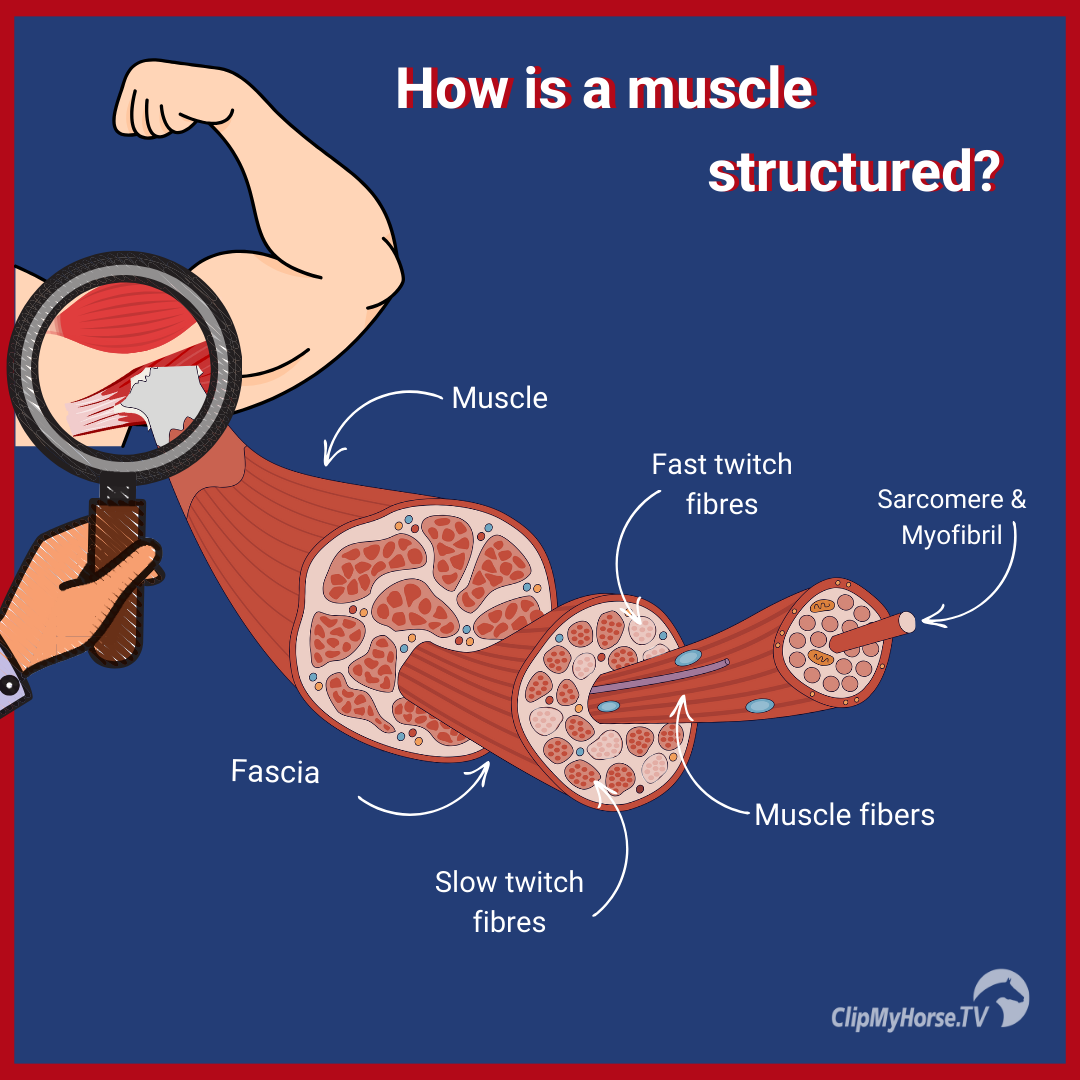
Every muscle is made up of muscle fibers, which we’ll explore in more detail below. These fibers contain fibrils, which are divided into structural units called sarcomeres. It’s in these sarcomeres that the protein filaments actin and myosin are found.
When a muscle is active and contracts, this process is called contraction. During this action, the protein filaments slide past one another and shorten. When the muscle relaxes (relaxation), the filaments move apart again.
There are different ways in which a muscle can contract, and understanding these is essential when selecting effective training exercises for muscle development in horses. We differentiate between three primary types of muscle contractions:
Isometric Contraction
Isometric contraction involves holding muscle tension without a change in muscle length. The muscle doesn’t shorten or lengthen, but the tension within the muscle increases. This often results in muscle tremors or shaking if the position is held for too long—a common experience for both humans and horses.
Examples in horses: When a horse lifts and holds a hoof in position without movement, the muscles are isometrically engaged. A rider maintaining a two-point seat (light seat) while the horse stands still engages core and thigh muscles in an isometric contraction.
Concentric Contraction
In a concentric contraction, the muscle shortens while generating force. This is the typical motion we associate with lifting or pushing. For the rider: Rising during the trot (similar to pushing up from a squat) requires concentric contraction of the quadriceps. For the horse: When pushing off the ground with the hindquarters to transition into canter, the muscles shorten concentrically—like the horse’s version of a squat.
Eccentric Contraction
The eccentric contraction is essentially the opposite of the concentric contraction. Here, the muscle lengthens while under tension, typically to control or decelerate a movement. For the rider: Lowering back into the saddle during posting trot involves the thigh muscles lengthening under load to avoid “plopping” down. For the horse: During stretching into a forward-downward frame, the neck muscles elongate to support and stabilize the movement while maintaining control of the head and neck.
Muscle Fiber Types in Horses
Every muscle is made up of long muscle fibers, and every horse has all types of muscle fibers. However, the ratio and distribution of these fibers can vary depending on the breed and genetics of the horse. Knowing the different muscle fiber types is essential for determining a suitable training approach and setting realistic performance goals.
There are three types of muscle fibers:
1. Slow-Twitch Muscle Fibers (Type I – Red Fibers)
- Responsible for endurance
- Function slowly but steadily over long durations
- Rely on aerobic metabolism (oxygen-dependent), burning energy efficiently over time
- Essential for long-distance riding, endurance racing, and stamina-based sports
2. Fast-Twitch Muscle Fibers (Type II – White Fibers)
- Provide explosive strength and speed over short bursts
- Operate anaerobically (without oxygen), using lactic acid fermentation for quick energy
- Crucial for sprint performance, powerful takeoffs, and high-speed work
3. Intermediate Muscle Fibers (Type IIa)
- A hybrid between slow- and fast-twitch fibers
- Offer a balance of endurance and power
- Can adapt through training depending on the discipline
Practical Application in Horse Breeds and Disciplines
Thoroughbreds and Arabians generally have a higher proportion of red (slow-twitch) fibers, making them naturally suited for endurance riding and racing. Quarter Horses, on the other hand, are dominated by white (fast-twitch) fibers, which makes them ideal for disciplines like barrel racing or cutting, where explosive power is required. Warmbloods, bred for disciplines such as show jumping, often have a balanced mix of fiber types. This is why they're especially well-suited for activities that demand both strength and endurance.
Understanding muscle function and fiber composition is critical for tailoring your horse’s training. Whether the goal is building endurance, increasing power, or achieving a balanced performance, knowing how equine muscles work is the foundation for smart, effective conditioning.
What Should You Feed to Build Muscle in Horses?
➡️ Video Tip: Muscle Building in Horses – Nutrition and Training in Focus!
Discover expert advice from Dr. Patricia Sitzenstock on the key nutrients essential for equine muscle development and how to combine smart training with optimal feeding strategies to support your horse’s performance and health.
💡 Learn how to effectively promote strong, healthy muscle growth in your horse – the right way!

To support healthy muscle growth in horses, their diet should be rich in high-quality proteins and essential amino acids. Supplements such as alfalfa, linseed oil, and specific amino acid preparations can be valuable additions. A well-balanced supply of vitamins and minerals, especially vitamin E, is equally important.
Just like in humans, nutrition plays a crucial role in helping horses reach their full athletic potential. Here are the core principles to consider when feeding for optimal equine muscle development:
Caloric Surplus – Building Mass Requires Energy
If you want your horse to build more (muscle) mass, it must consume more energy than it burns—this means achieving a caloric surplus. To monitor whether your horse is eating enough, regular weigh-ins and progress photos are recommended. Horses that are hard keepers, seniors, or growing youngsters often require more calories than average. In these cases, a nutrient-dense concentrate feed may be necessary, especially if the horse doesn’t gain weight despite free-choice hay.
Forage First – Quality and Quantity Matter
Adequate hay and minimal fasting periods (no more than 4 hours without feed) are essential for healthy muscle development. As natural grazers, horses are designed to eat continuously—too little forage or poor hay quality can lead to digestive problems, ultimately slowing or preventing muscle growth. Hay forms the foundation of every equine diet.
A useful rule of thumb for hay feeding:
👉 Minimum of 1.5 kg dry matter per 100 kg of body weight per day.
It's important to understand that 1.5 kg of dry matter is not the same as 1.5 kg of hay.The actual weight depends on the specific hay or haylage being fed. On average, hay contains about 85% dry matter. Based on this, the formula would require at least approximately 1.8 kg of hay per 100 kg of the horse’s body weight.A 500 kg horse should therefore be provided with a minimum of 9 kg of hay per day to support healthy digestion and optimal muscle development.
Mineral Supplements for Muscle Development in Horses
A high-quality mineral feed should compensate for nutrients that are often lacking in hay. This ensures your horse avoids both deficiencies and harmful excesses of essential minerals and vitamins. For an accurate assessment, it is strongly recommended to have a forage analysis conducted by a certified lab such as LUFA (Agricultural Research and Testing Institution). This helps determine the exact nutrient content of your hay and guides you in selecting the most appropriate mineral supplement.
Pro tip: Consult an independent equine nutritionist to tailor the feeding plan specifically to your horse’s needs and optimize overall health and performance.
It's important to note: Rapid muscle gain cannot occur if a horse suffers from nutrient deficiencies. For example, zinc is often under-supplemented, yet it plays a critical role in hoof and hair growth and especially in wound healing. If the immune system is constantly battling unresolved inflammation due to zinc deficiency, muscle development may slow down significantly.
While the horse can tolerate a zinc surplus of up to four times the required amount without health issues, even a slight excess of selenium may lead to selenium toxicity—a potentially serious condition. On the other hand, selenium deficiency can prevent weight gain and muscle building, regardless of how much you feed. This is why selecting the right mineral feed is not just relevant to muscle growth, but to your horse’s overall health and metabolic balance.
📖 Recommended reading:
Supplements & Minerals for Horses – What Does Your Horse Really Need?
Learn how to recognize nutritional gaps, which supplements truly make sense, and how feeding plays a vital role in your horse's everyday health and performance.
Protein
Proteins (amino acids) are the building blocks of muscle, making protein-rich feeds a critical component in any horse’s muscle development plan. Feeds like alfalfa, soy, or even oats can serve as valuable protein sources. Conducting a forage analysis helps determine the protein levels already present in your hay and how much additional supplementation may be necessary. In fact, protein deficiency is far more common in horses than many believe. Without enough protein, muscle development is impossible—no matter how well you train or condition your horse. Just like with minerals, the fear that excessive protein could damage the horse’s liver or kidneys is a myth. Protein oversupply is generally harmless in healthy horses. Pay attention to the amino acid profile of your protein sources. Proteins are made up of various amino acids, and a diverse profile ensures that all metabolic and muscle-building processes are supported.
Which Amino Acids Are Crucial for Equine Muscle Development?
Essential amino acids such as:
- Lysine
- Methionine
- Threonine
...are particularly important for protein synthesis and therefore for muscle growth in horses. Ensuring adequate intake through balanced nutrition is crucial.
Muscle Building in Horses – Training Plan
Once you understand the anatomy and function of equine muscles, you can build a training plan tailored to your horse’s needs. Below are the key components to consider when structuring an effective muscle-building program for horses:
Define a Training Goal
Setting a clear and realistic training goal is the foundation of a successful muscle development plan. For sport horses, this might be preparing for a specific competition—e.g., jumping a certain height or performing specific dressage movements. In the recreational sector, a goal could be:
"By next winter, my horse should be fit enough to canter 10 minutes non-stop in the arena to improve lung capacity and reduce coughing." or like
"Next summer, I want to go on a 3-hour trail ride with my horse and a friend."
With a clear goal in mind, you can determine which muscle fiber types to target and which types of muscular contractions are most relevant. Make sure your goals are realistic and measurable, and always allow more time rather than less to achieve them.
Determine Training Volume
Training volume is a combination of: Intensity (e.g., heart rate, speed, duration, jump height, number of flying changes), Frequency (e.g., how many sessions per week) and Duration (e.g., how long each training session lasts). Balancing these three factors is crucial for building equine muscle effectively and safely.
Measurability & Documentation
What gets measured gets improved! The more measurable your training plan, the more obvious your horse's progress becomes. When you see your horse every day, it’s easy to miss subtle changes—this is why documenting training is so important. Use photos, videos, or apps to track changes. Heart rate monitors can help assess fitness level and training load. Document both successes and setbacks to adjust your plan as needed
Schedule Recovery Time
Muscles don’t grow during training—they grow during recovery. Therefore, planning rest and regeneration is just as important as the training itself.
Active recovery days (e.g., hand-walking, light lunging, stretching) are ideal—especially when your horse has mild muscle soreness. Just like in human athletes, movement can help relieve muscle stiffness better than complete rest.
🗓️ General Training Frequency Guidelines:
- 0–2 sessions/week → No muscle growth or even muscle loss
- 3 sessions/week → Maintenance of current muscle mass
- 4–6 sessions/week → Optimal muscle building
- 6–7 sessions/week → Risk of overtraining, muscle gain may be compromised
These are only general recommendations. Always adapt based on:
- The horse’s current fitness and health status
- Mental condition
- Living environment (e.g., box, pasture, active stabling)
- Age and training history
A good rule of thumb: Plan 1–2 rest or active recovery days per week to support optimal muscle development and long-term soundness.
Consider Limitations
When planning muscle development for a horse, it’s essential to recognize that multiple factors can limit progress. The goal is always to make training stress itself the limiting factor, while eliminating other obstacles that could impede performance or wellbeing.
The true limiting factor is what ultimately brings the horse to fatigue. Ideally, this should be a sign of muscular challenge — such as a lack of strength — rather than discomfort or pain caused by poorly fitting equipment.
A poorly fitting saddle or a bit that pinches can interfere with the horse’s ability to collect, respond quickly and softly to aids, or achieve proper shoulder freedom. Pain or discomfort of this kind dramatically affects relaxation and suppleness, which are prerequisites for effective muscle engagement and development.
Mental wellbeing must also be taken into account. True relaxation in the horse includes its psychological comfort. A horse that becomes anxious when the rider mounts is unlikely to be ready for demanding movements such as canter pirouettes. Lack of focus or distraction can exhaust the horse cognitively before its muscles are even challenged. The horse’s living environment and daily routine also have a significant influence on its general motivation and willingness to work.
Restricted mobility is one of the most common limiting factors in muscle development. A qualified equine osteopath or physiotherapist can help improve mobility, but flexibility should also be actively incorporated into training and warm‑up routines. If a horse cannot move its forehand and hindquarters independently, performing correct lateral work — involving coordinated use of hindquarters, back, and core — becomes extremely difficult.
Pain and injury are other factors that slow down or inhibit muscle gain. When the body is preoccupied with healing a wound or fighting illness, the immune system naturally prioritizes survival over building muscle. Conditions such as arthritis can reduce range of motion, and issues like gas discomfort or dental pain can have similarly limiting effects. Growth spurts in young horses also temporarily impact muscle development due to rapid skeletal growth outpacing muscular adaptation.
Even muscle soreness (DOMS) can be a limiting factor. Contrary to popular belief, soreness is not a sign of an excellent training session; it is a result of tiny microscopic tears in the muscle. While mild soreness may be normal when beginning a new routine, persistent or severe soreness indicates overtraining and should not be encouraged.
The fitness of the rider also plays a role. A fit horse needs a fit rider. Effective muscle development requires good body control, and a tense or unbalanced rider can interfere with the horse’s movement patterns. For example, an experienced rider engages the core rather than gripping with the entire leg and hip — a subtlety that improves the horse’s comfort and facilitates better muscle engagement. In many cases, a “warm‑leading” session (walking the horse before mounting) can be more effective than traditional warm‑up routines.
Putting a Muscle Building Training Plan into Practice
A training plan alone won’t magically add muscle — it must be implemented intelligently.
Muscular Imbalance in Horses
Just like humans are born right- or left-handed and tend to favor one side for writing or physical tasks, horses are born with a natural asymmetry — often referred to as their "chocolate side" or preferred side. Essentially, this means that during the approximately 23 hours a day when the horse is not being ridden or trained but moving freely, it tends to use one side more than the other.
For example, a horse may turn more easily to the left when moving around its stall or naturally choose the left lead when galloping in the pasture with other horses. This unconscious preference over time leads to muscular imbalance, as one side is consistently more engaged than the other.
Since most horses are only actively trained for about an hour a day, it becomes the rider’s or trainer’s responsibility to counteract this imbalance during that time. A useful guideline is to work the horse two-thirds of the time on its weaker side and one-third on the stronger side. Alternating between the good and the less-developed side keeps the horse mentally engaged and helps create positive learning experiences, rather than constant challenge or frustration.
Balancing both sides not only supports even muscle development, but also improves straightness, suppleness, and performance across all disciplines.
Form Follows Function
The expression “form follows function” emphasizes choosing exercises for their biomechanical purpose — not for how they look. A classic example is head position. Forcing a horse into a specific frame before it has the strength and coordination to achieve it creates negative tension, which inhibits muscle development. Instead, begin with exercises that strengthen the hindquarters and back so the horse can develop positive engagement. Only then will self‑carriage and correct elevation become a natural outcome that can be carried across all movements.
Strength vs. Endurance
Improving endurance primarily targets slow‑twitch (red) muscle fibers. Endurance training requires sustained, even work — for example, 20 minutes of continuous trot with minimal transitions. In endurance training, the focus should be on gradually extending time or distance before increasing speed. For instance, progress from 20 to 25, then to 30 minutes of steady trot before introducing canter work.
By contrast, strength‑building exercises recruit fast‑twitch (white) fibers. Movements that promote strength include lateral work, flying changes, collected canter, transitions that require impulsion, or gymnastic patterns that demand power. In Western disciplines, strength develops through maneuvers such as sliding stops, spins, and rollbacks.
Which fiber type you emphasize depends on both the training goal and the limiting factor. At the end of a session, is the horse fatigued because of a lack of strength or because of limited stamina? Understanding this distinction helps you tailor the session to the horse’s individual needs. Most disciplines require a blend of both endurance and power, so it helps to consider how much of your training should build stamina versus strength.
Effective Muscle Building Exercises for Horses
Each exercise should have a clear purpose, and the horse should understand its function so the learning transfers to other movements. Starting exercises from the ground can be beneficial because it allows you to observe footfall patterns and reduces load before progressing under saddle. Groundwork builds body awareness and coordination, which supports later ridden strength work.
High‑Intensity Interval Training (HIIT) for Horses
High‑Intensity Interval Training (HIIT) is highly effective for strength development. For example, allow the horse to canter continuously for 5 minutes, then walk for 1 minute, or perform a structured pattern at the walk. Alternating brief periods of high intensity with low intensity not only strengthens muscles but also improves the horse’s ability to manage energy. This helps prevent the horse from exhausting itself early in a session and maintains performance throughout the workout.
Muscle Building from the Ground
Contrary to common belief, horses do build muscle through well‑designed groundwork. Although the load is reduced without a rider’s weight, horses still carry and balance their own mass — often 500 kg or more. With well‑structured ground exercises that encourage balance, engagement, and correct body use, horses can develop strength that transfers directly into ridden work.
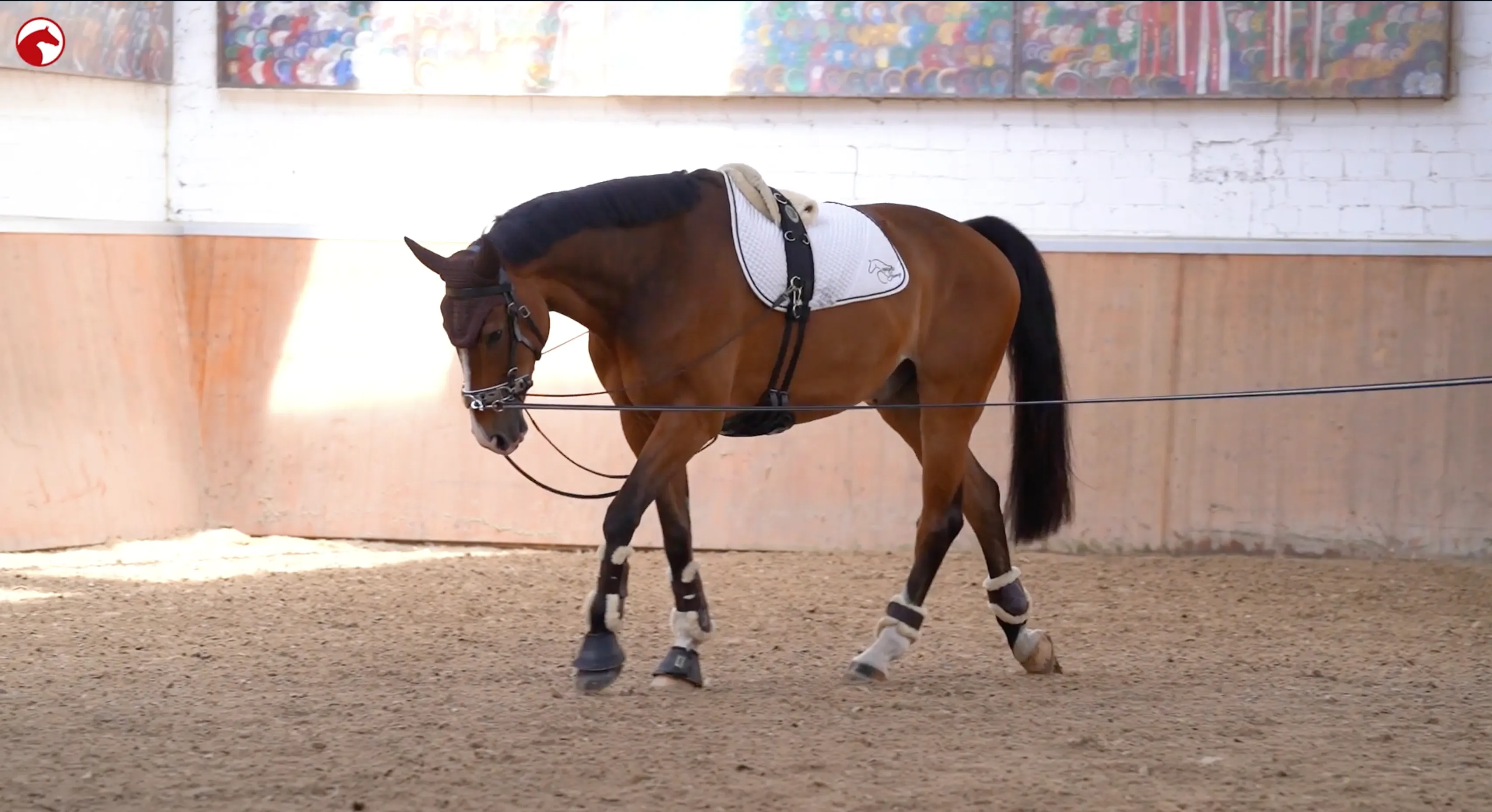
Lunging Work
Lunging exercises are highly effective for muscle development and improving a young horse’s ability to carry weight behind. Direction changes on the lunge line are especially useful, because they encourage the horse first to step under with the hindquarters and then to yield correctly with the forehand before transitioning into a new gait with increased hindquarter engagement. Additionally, reducing the circle size has a similar effect to increasing resistance in a gym — the smaller the circle, the greater the load on the hindquarters. This promotes strength and coordination deep within the topline.
📖 Reading Tip: “Lunging Made Easy – How to Do It Right!”
Lunging is far more than just walking your horse in a circle. It improves balance, builds muscle, and enhances communication between horse and handler. Learn which techniques are truly effective and how to avoid common mistakes!
Groundwork
Groundwork also plays a major role in improving mobility. For example, shoulder and chest muscles benefit significantly from exercises such as short reversals on the lead as they encourage suppleness and engagement. Lateral movements and initial leg‑yielding can also be introduced from the ground, allowing the horse to learn balance and coordination before these patterns are asked under saddle.
The use of a double lunge is another excellent tool for shaping the horse’s body and enhancing musculature without the added weight of a rider. It encourages the horse to lift through the back, engage the hindquarters and achieve a more athletic frame.
Muscle Building While Riding
Many exercises introduced from the ground can and should be transferred to ridden work. As the horse moves with increased tempo and greater engagement through its own body, it often must carry more weight, particularly through transitions. Transitions are among the most effective tools for developing the back and core musculature. Don’t shy away from challenging transitions such as moving directly from rein back into canter, or vice versa.
Pole work provides a further opportunity to influence stride length, engagement, and impulsion. Rails can be placed to create gymnastics that build strength and coordination. Especially for younger horses, pole work adds valuable variety to the training routine. It not only aids muscle development, but also improves rhythm, balance and proprioception.
📖 Reading Tip: “Cavaletti Training – More Variety and Gymnastics for Your Horse”
Cavaletti poles are versatile training tools that benefit horses across disciplines, not just jumpers. They enhance coordination, muscle development and balance — both on the lunge and under saddle. In this article, you’ll learn how to use cavaletti effectively for gymnastic training, find ideal spacing and height recommendations, and discover ways to keep sessions engaging and productive — read now!
Generally, it’s helpful to ask for the opposite of what the horse is trying to do. If your horse rushes into a jump or a movement, slow the tempo and ask for a balanced trot over poles instead. If the horse lacks energy, ask for more active impulsion. Because horses are natural energy savers, they tend to adopt postures that require the least effort — just as a rider might slump into a more comfortable but unhealthy seating position. Active uphill work during trail riding is another excellent way to build deep musculature, as even gentle inclines require the horse to engage core and hindquarter muscles more intensely.
Muscle Building in Older Horses
Once a horse reaches a certain age, building new muscle becomes more difficult and in some cases may no longer be fully possible. This makes consistent training especially important in older horses. A fit senior horse often lives longer, stays sounder and may also save owners significant veterinary costs by preserving mobility and strength. Because older horses tend to adopt protective postures, training should focus on maintaining muscle mass and preventing muscle loss through tailored conditioning and gymnastic work.
How Long Does It Take for a Horse to Build Muscle?
In general, muscle development in horses takes several weeks. Most horses will show the first visible signs of improvement within about three weeks of consistent, structured training. The principle of progressive overload describes how muscles grow through systematic, incremental increases in training intensity and volume. Training cycles that gradually increase workload provide the stimulus for muscular adaptation.
If after about three weeks no progress is apparent, the training plan should be reviewed and adjusted. In cases where a horse has experienced a period of rest due to injury, recovery time, or illness, research and experience suggest that regaining lost musculature typically requires approximately twice the duration of the break, due to the beneficial effects of muscle memory.
Summary: Muscle Building in Horses
Muscle development in horses is a complex process that requires in‑depth understanding of muscle structure, contraction types and fiber composition. A successful conditioning program is built on a balanced combination of targeted training and optimal nutrition. Adequate feeding — including sufficient protein, essential minerals, and an appropriate calorie surplus — is just as crucial as the physical training itself.
A training plan should be progressive and measurable, with enough time allotted for regeneration, because muscles grow during rest, not during the workout. Training should include a mix of isometric, concentric and eccentric contractions, and work that stimulates both slow‑twitch (endurance) and fast‑twitch (strength) fibers, depending on the goals of each session.
In addition to structured training and nutrition, attention should always be paid to proper equipment, the horse’s mental wellbeing, and individual physical limitations to ensure training is both effective and gentle. While muscle development generally becomes noticeable after about three weeks of consistent work, horses returning from injury or rest may need a slightly longer, tailored approach.
Overall, building and maintaining muscle in the horse is a continuous journey that requires patience, knowledge, and a personalized approach to training and care.
You might also like