The Horse Saddle: Structure, Fits, and Differences
Get to know the different types of saddles and their uses, how to saddle a horse correctly, and how to ensure your saddle fits perfectly.
Table of Contents
Some people may wonder what a saddle is used for in equestrian sport. Horse saddles are an important part of riding. Without the right saddle, it’s difficult for horse and rider to ensure good communication and a comfortable riding experience. In this article, we’ll answer the most important questions about saddles so you can support both your horse and yourself in the best possible way.
What is a horse saddle made of?
Classic horse saddles used in jumping, dressage, and eventing generally have the same basic structure (except for treeless saddles). These saddles typically consist of a saddle tree, a gullet with a headplate, a pommel and cantle, saddle flaps, panels, a sweat flap, and girth straps (billets).
.webp)
The heart of the saddle: the saddle tree
As mentioned, all classic riding saddles—except treeless saddles—have a saddle tree. But why do saddles have a tree, and what role does it play in jumping, dressage, and eventing saddles?
The saddle tree determines the saddle’s basic shape. Naturally, the curve of the tree must match the horse’s back, even though small differences can later be compensated for through the saddle’s flocking. It’s important that the tree is highly durable, yet still able to move in harmony with the horse’s motion.
In the past, saddle trees were made of wood. Today, they may also be made from spring steel, fibreglass, or plastic. Plastic and fibreglass trees are very flexible and lightweight, but they generally cannot be adjusted to the horse later on because they are moulded.
The safety stirrup bar, where the stirrup leathers are attached, is located on both sides of the saddle. In the event of a fall, it typically releases so the stirrup leathers can detach and the rider is less likely to be dragged.
Safety and stability: the gullet and headplate
In English saddles, a headplate (gullet plate) is standard. It sits at the front of the saddle tree and above the withers. Many saddle models feature adjustable headplates that can be changed in stages or swapped out entirely.
Why does a saddle need a headplate?
The answer is simple: English saddles are designed primarily for classic disciplines such as jumping, dressage, and eventing—where it’s important to give the horse precise aids, for example when jumping or performing dressage movements.
Another key aspect is safety. The headplate helps prevent the saddle from sliding backward during movement and gives the rider better security in the saddle and more control if the horse spooks or reacts unpredictably.
In addition, the headplate helps reduce pressure on the horse’s spine and contributes to proper weight distribution. Of course, optimal weight distribution requires a correctly fitted headplate, so the saddle can support both horse and rider, allow free movement, and minimise the risk of injury.
- A too-wide headplate can cause pressure points because the saddle may drop onto the withers, which is painful for the horse.
- A too-narrow headplate can also cause pain by pinching the muscles around the withers; it can make the saddle unstable and prevent it from sitting correctly.
That’s why it’s important to have the saddle checked regularly—or whenever you notice changes in the horse’s way of going or under saddle—by a qualified saddle fitter.
What about Western saddles?
Some Western saddles do not have a headplate. Saddles used for cattle work and rodeo riding may omit it because free movement of the neck and head is required. While a headplate would stabilise a Western saddle, it could restrict the movements needed for that type of work.
What is the “gullet”?
The open space between the ends of the headplate and the withers is called the gullet. You may have heard the term “to clear the saddle pad”—this refers to pulling the pad or saddle cloth up into the gullet to create a channel and prevent pressure on the withers.
From pommel to cantle
The pommel and cantle are key components of every riding saddle. They form the front and rear boundaries of the saddle and play a major role in rider comfort and the horse’s freedom of movement. Especially in jumping and gaited-horse saddles, the balance of the seat and the height of the cantle are crucial. A well-fitted saddle allows the rider to stay secure in the saddle while jumping or riding faster gaits, and it supports the horse’s movement.
The size of the seat is also very important. A saddle that is too small causes discomfort for the rider and can restrict the horse’s movement. A saddle that is too large, on the other hand, does not provide enough support and can cause the rider to slide around while riding.
A correctly fitted saddle is essential for a comfortable seat. The saddle should be balanced so that the rider’s centre of gravity sits in the middle of the seat. This ensures optimal weight distribution and minimises pressure on the horse’s back.
The saddle flap
This is where the rider’s legs rest. The flap provides support and helps the rider maintain the correct position for the specific discipline. The saddle flaps hang down on the left and right side of the saddle, and their cut depends on the type of saddle—more about the different saddle types is covered in the next section.
You’ll also find the knee rolls (blocks) at the front of the flap. They support the rider’s knee and can be more or less pronounced depending on the saddle.
The billets and the sweat flap under the saddle flap
On saddles that do not have a monoflap design, there are usually 2–3 billets under the saddle flap. Their length can vary depending on the discipline: dressage saddles typically have longer billets, while jumping and eventing saddles tend to have shorter billets.
With long billets, a short girth is used so the buckles don’t sit uncomfortably under the long, straight leg of the dressage rider. With short billets, you usually use a long girth. However, it’s also possible to use a short girth with short billets by adding a girth extender.
The saddle panels
The saddle panels underneath the saddle are crucial for both horse and rider comfort. They sit directly on the horse’s back (or on the saddle pad), keep the spinal channel clear, and are typically filled with flocking wool.
The shape of the panels is essential for how the saddle fits the horse’s back. Wider panels create a larger contact area and therefore improve pressure distribution. Panel shape also affects the rider’s closeness to the horse: wide, flatter panels allow the rider to sit closer, while narrower, more rounded panels create more distance.
The length and shape of the panels must be matched to the horse’s individual back shape. There are different types, including banana panels for short, curved backs and wedge panels for long, straighter backs. Banana panels follow the saddle’s curve and are therefore better suited to short backs, while wedge panels extend the bearing surface and increase the contact area.
Panels can also be attached to the saddle in different ways. Standard panels are stitched directly to the saddle, while French panels are mounted with screws. The latter can offer the advantage of adapting more easily to the horse’s bend, which may improve freedom of movement.
Saddle panels are a key part of the saddle and contribute significantly to comfort for both horse and rider. With regular maintenance and the right panel choice, pressure points can be avoided and saddle fit can be optimised—supporting a safe and enjoyable riding experience.
What types of saddles are there for horses?
There are many different types of saddles for horses. In addition to the saddles used in classical equestrian sport—such as jumping, dressage, or eventing saddles—almost every riding discipline has its own saddle designed to meet the needs of both horse and rider.
The jumping saddle
As the name suggests, this saddle is most commonly used for show jumping. Thanks to the short saddle flap, which is cut further forward toward the horse’s shoulder, the rider’s knee has more support and the rider can more easily lighten the horse over a fence. The saddle’s headplate sits behind the shoulder to maintain shoulder freedom so the horse isn’t restricted in its movement.
The seat of a jumping saddle is flatter, allowing the rider to lift more easily out of the saddle in canter or over jumps. There are three main seat depths in jumping saddles:
- Deep seat: Provides a stable, secure feel and positions the rider’s leg more firmly.
- Flat seat: Offers maximum freedom of movement; it requires a well-balanced seat from the rider.
- Semi-deep seat: Provides stability without restricting freedom of movement.
The best option depends on what feels right for you—ideally, try different models. You can let your saddle fitter know before your next appointment so they can bring a selection for you to test and find what suits you best.
A jumping saddle also requires a girth—most commonly a long girth. Long girths come in different versions: a stud guard girth with a sturdy belly flap helps distribute pressure and protects the horse from injury caused by studs. Long girths are also available in leather, as a string girth, with lambskin or faux fur, with teddy fleece, or with memory foam. So-called elastic girths are also becoming increasingly popular: they have an elastic insert between the buckle and the girth, making it easier to girth up because it gives with the horse’s breathing.
This type of girth is typically preferred for pressure-sensitive horses, as the pressure increases gradually rather than abruptly. When using a girth with elastic on one side, the non-elastic side should be used for re-girthing to prevent over-tightening.
Alternatively, string girths can be used, as they have a natural baseline elasticity. They are suitable for both young horses and experienced horses. A string girth can also be re-tightened easily from the saddle without the risk of pulling it excessively tight.
The dressage saddle
Dressage places different demands on the saddle, the rider, and the horse than a jumping saddle does. The rider generally wants to sit as close to the horse as possible. With its deeper seat and a long, straight-cut flap, the dressage saddle also supports a controlled, upright position. For that reason, this type of saddle is usually not well suited for show jumping or eventing.
Knee blocks on the flap frame the rider’s leg, which means there is less freedom of movement. Dressage is the foundation of every classical riding discipline—jumping riders also need solid dressage basics to guide their horse successfully through demanding courses.
There are different types of dressage saddles, such as monoflap dressage saddles. As the name suggests, these saddles have only one flap and offer very close contact with the horse. Dressage saddles typically have very long billets, which is why a short girth is often used—so the buckles don’t interfere with the rider’s thigh. However, some dressage saddles—especially those without a monoflap—also have holes higher up on the billets so a long girth can be used if needed.
Just like long girths, short girths come in many versions: with or without lambskin, made from leather, neoprene, or nylon—and string girths are also available in a short version. Anatomically shaped girths are becoming increasingly popular as well. A crescent (“moon”) girth, for example, can suit horses with a rounder build and a short back; its special shape helps prevent the saddle from slipping by following the ribcage curve.
If you’re wondering which girth fits your horse best, your saddle fitter or a specialist tack shop can usually advise you most effectively.
The eventing saddle
In eventing, riders often need both a dressage saddle and a jumping saddle. An eventing (all-purpose) saddle is a combination of the two. It typically combines more supportive knee and calf blocks with a semi-long flap that is cut slightly forward.
The girth length that can be used depends on the saddle’s balance point, because there are also all-purpose saddles with a stronger focus on dressage (VSD) or jumping (VSS)—each one is a bit closer to the requirements of that discipline.
- A VSD saddle usually has a slightly longer flap and long billets.
- A VSS saddle is cut shorter and has short billets for use with a long girth.
By adjusting the stirrup leather length, an all-purpose saddle can be used for dressage, jumping, or cross-country riding. With longer stirrups, the rider can sit with a long, straight leg without being restricted by the blocks. With shorter stirrups, the eventing saddle provides excellent security in the field, over fences, and in a light seat.
The Western saddle

A key difference between a Western saddle and an English saddle is the weight, but also the size, because a Western saddle generally offers a larger seat. Western saddles were designed to meet the demands of ranch work during cattle handling on vast ranches in the United States. This meant the cowboy had to sit comfortably in the saddle for hours, have enough space for equipment, and—especially during cattle work—the saddle had to be extremely robust and not fail under heavy pulling forces.
Western saddles are heavier than the English-style saddles we know. A Western saddle can weigh close to 20 kg, and its basic construction has changed very little over time. However, there are newer innovations that make some models lighter.
Because there are different Western competition disciplines, there are also different types of Western saddles:
- Reining saddle: Large seat, slightly raised cantle, low horn for better rein handling
- Cutting saddle: Deep seat, high fork, narrow horn, flexible fenders, additional back cinch for stable positioning
- Roping saddle: Wide, sturdy horn, low cantle, heavy construction
- Barrel racing saddle: Short saddle, high fork, lightweight, steep/high cantle
- Trail saddle (Old Timer): Wide padded seat, deep seat, large bearing surface
- Pleasure saddle: Cut-out skirt for closer contact with the horse, eye-catching design, rough seat surface
Western saddles have also become increasingly popular among leisure riders. They can provide a very comfortable seat on long rides and—thanks to their large bearing surface—good weight distribution for the horse, as long as the saddle fits correctly. Here too, specialised saddle fitters can help you find the right model for you and your horse.
For a Western saddle to sit well on the horse’s back, it should meet the following points:
- It should not restrict the horse’s shoulder freedom of movement.
- It should not interfere with the horse’s bending.
- It should not disturb the transition between the thoracic and lumbar spine.
- It should not touch the withers or spine, and should not sit too close to them.
- The bearing surface must match the rider’s weight and the intended duration of use.
- The underside of the saddle should allow the horse to move freely—both in relaxed walk and with a lifted/rounded back—without restriction.
How do I find the right saddle for my horse?
A well-fitting saddle is one of the most important pieces of equipment for keeping your horse healthy when riding. Choosing the right saddle is essential to prevent damage to your horse’s back. You’ll know you’ve found the right saddle when your horse’s movement is not restricted and the saddle does not create pressure or pain.
A qualified saddle fitter or specialist tack shop can help you choose the right saddle by assessing and measuring the size and shape of your horse’s back. Make sure you can try the saddle before buying—the fitter can then evaluate, based on the horse’s movement (and the saddle’s movement), whether the saddle suits both the horse and the rider. In many cases, you as the rider will quickly feel whether the saddle not only fits the horse, but is also comfortable and suitable for you.
This video from the ClipMyHorse.TV Academy shows you how to spot a poorly fitting saddle and why saddle pressure can have serious consequences for your horse’s movement, musculature, and overall well-being.
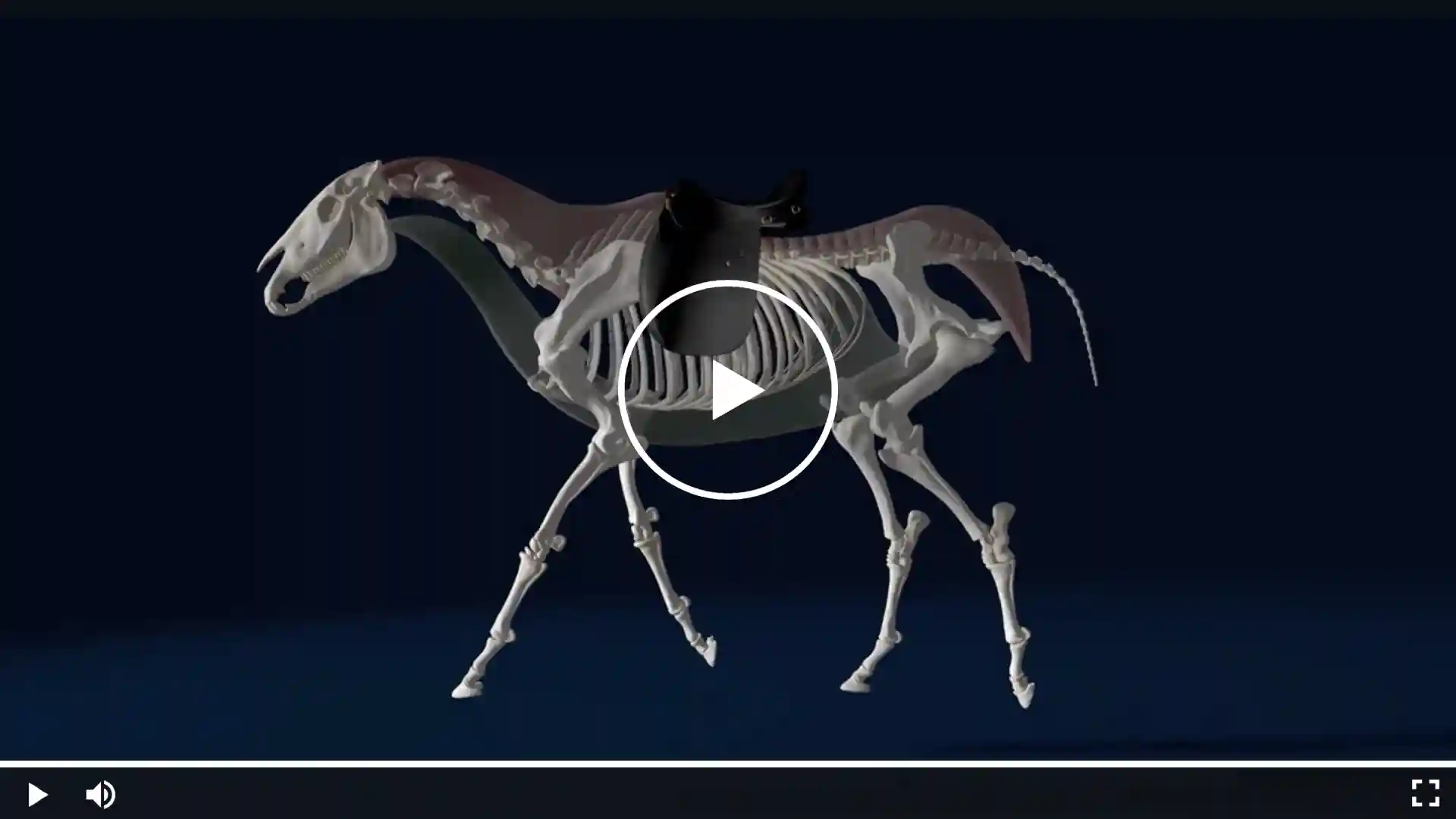
How should a saddle sit correctly on a horse?
An English saddle should sit on the horse’s back in a way that creates as little pressure as possible and distributes weight evenly. It should also remain stable and not slip too far forward or backward.
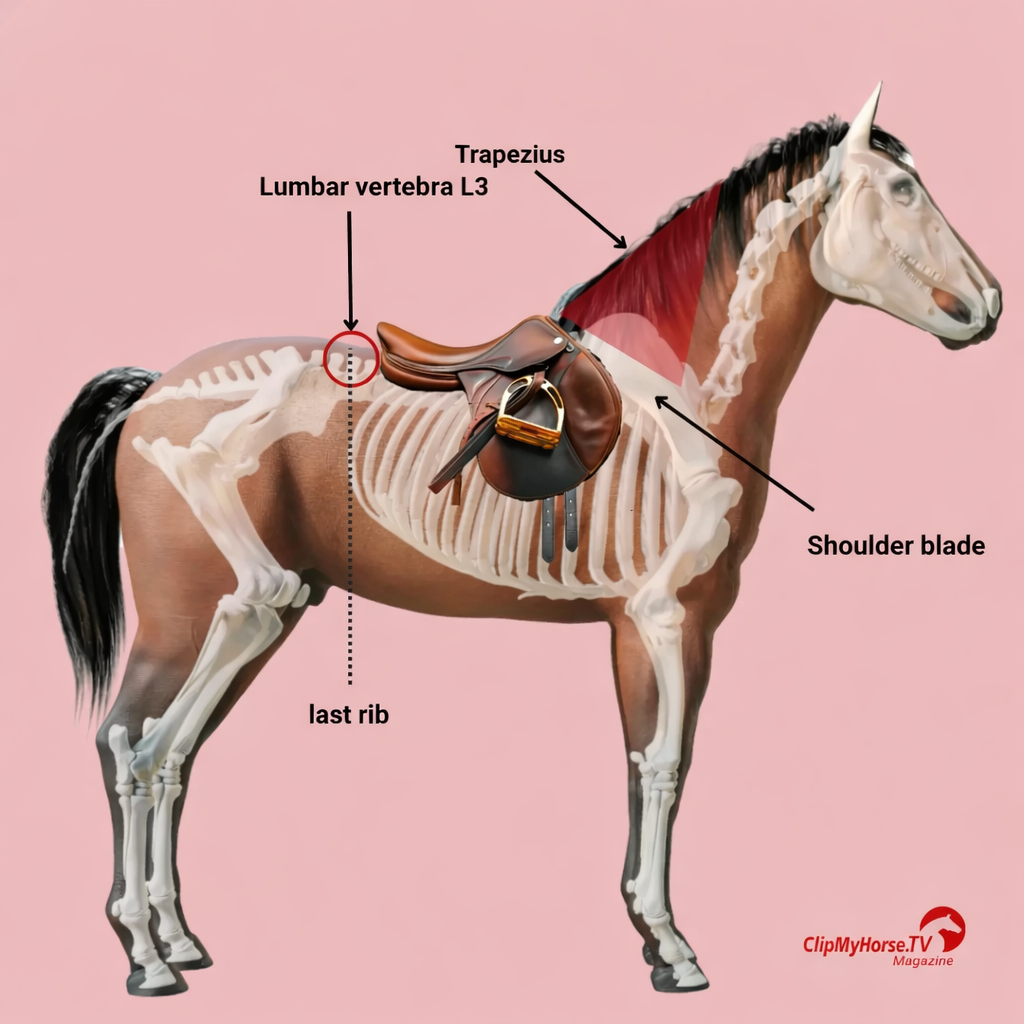
In general, you—and especially your saddle fitter—should pay attention to the following points:
- The saddle sits 2–3 fingers behind the shoulder blade and does not restrict it.
- The saddle provides enough clearance for the spine and spinous processes.
- The saddle’s gullet/channel is at least 3–4 fingers wide לאורך its full length.
- The saddle should not extend beyond the last rib (L3 region).
- The saddle’s balance point (where most of the rider’s weight is distributed) should lie in front of T18.
- The panels should not extend into the area where the long back muscles transition into the ribs.
- The billets and girth should hang straight down and sit about a hand’s width behind the horse’s elbow, so the girth still lies on the sternum.
Saddle position can be adjusted with different girths and padding. However, keep in mind that correcting saddle fit with pads, elastics, or sheepskin is not a long-term solution for an ill-fitting saddle. These should only be used as a temporary measure until the next saddle fitting appointment.
In growing horses or older horses, saddles often need more frequent adjustments or reflocking because the horse’s musculature can change continuously. A young horse may build muscle quickly and is still developing—so a pad can be a practical short-term option to keep working the horse until the saddle fitter can properly adjust the saddle.
9 tips for saddling correctly: How to saddle your horse properly
Before you saddle your horse, you should groom and brush it thoroughly to remove loose hair and dust. Then place the saddle carefully on the horse’s back and adjust the girth to make sure the saddle sits correctly. It’s important to observe your horse to ensure it is comfortable and that the saddle isn’t pinching or slipping.
Step-by-step instructions for saddling a horse correctly
- Place the saddle on a saddle trolley, saddle rack, or the stable door, making sure the stirrups are run up on both sides. You can lay the girth over the saddle or keep it beside you.
- If the saddle pad is already attached under the saddle, skip steps 2 and 3.
- Place the saddle pad on the horse’s withers so that about half of the pad/saddle cloth lies in front of the withers.
- Place the saddle on top of the pad and pull the pad smooth and up into the gullet. The pad should always sit centred.
- Once the saddle and pad are on the withers, slide both slowly backward. On some horses, you can feel the saddle “settle” into place—otherwise, slide the saddle to the lowest point of the horse’s back.
- You can check whether the saddle is correctly positioned by ensuring there is at least two fingers’ clearance between the shoulder blade and the front edge of the knee blocks.
- Move to the other side (the horse’s right side) and check that the pad is lying straight and not trapped under the saddle. If it’s straight, thread the girth on the right side through the billets and fasten it.
- Go back to the left side and tighten the girth. It should be snug but not restrict the horse’s breathing—so the saddle doesn’t slip or even fall off on the way from the grooming area to the arena.
- To check whether the saddle and girth are positioned correctly, slide your hand between the elbow and the girth. If about a hand’s width fits between the foreleg and the girth, the girth is positioned well.
Great—your saddle should now be secure. You can adjust your stirrups and, after bridling, head to the arena. Don’t forget to re-check and tighten the girth again before mounting.
Saddles for horses: Summary
The range of saddles available for horses is almost endless—making it all the more important to find the right fit for both horse and rider. The goal is a saddle that feels comfortable not only for the rider, but also for the horse. An incorrect or poorly fitting saddle can cause significant harm: it doesn’t just lead to back problems, it can also negatively affect the horse’s entire musculoskeletal system and movement.
That’s why it’s always advisable to buy a saddle through a qualified saddle fitter and have it checked regularly. And you don’t necessarily need to purchase a brand-new saddle—many fitters also offer used saddles that can be adjusted to suit your horse.
Horse saddles: Key questions and answers
Which saddle is most comfortable for the horse?
The most comfortable saddle for a horse is one that is professionally fitted to the horse’s anatomy and individual needs. A well-fitting saddle distributes the rider’s weight evenly and avoids pressure points. There is no “one-size-fits-all” saddle—having a qualified saddle fitter check and adjust the saddle is essential.
Which saddle suits horses with a short back or wide, compact horses?
For horses with a short back or a wide, compact build, saddles with a short bearing surface are ideal. Models with wide gullets and short panels—such as certain dressage saddles or treeless saddles—can be good options. The key is careful fitting to ensure freedom of movement and comfort.
Which saddle fits every horse?
There is no saddle that truly fits every horse, because each horse has unique conformation. Treeless saddles and adjustable saddles (e.g., some Wintec models) can be adapted to many horse types, but you still need to check the fit thoroughly before buying.
Can a Wintec saddle be adjusted (or have it adjusted)?
Yes. Wintec saddles are known for being adaptable. With the Easy-Change system and interchangeable gullets, the width can be adjusted. For optimal fit, a professional saddle fitter can also help fine-tune the saddle.
What does “CAIR” mean in Wintec saddles?
The CAIR system is a special padding technology used in many Wintec saddles. It uses air-filled panels designed to distribute pressure evenly across the horse’s back, increase comfort, and improve shock absorption. It also helps the saddle adapt to the horse’s movement.
Do Wintec saddles have a saddle tree?
Yes, most Wintec saddles have a flexible saddle tree. It is designed to distribute the rider’s weight evenly while allowing some flexibility with the horse’s movement. The Easy-Change system supports individual adjustment.
How do I adjust a Wintec saddle?
A Wintec saddle can be adjusted using the Easy-Change gullet system (by swapping the gullet plate to change the width) and, depending on the model, the CAIR system. To ensure the saddle truly fits the horse, it’s best to involve a professional saddle fitter.
How do I find the right saddle for my horse and me?
Finding the right saddle requires careful assessment of both the horse’s back shape and shoulder area and the rider’s needs (seat size, balance, flap shape). A well-fitting saddle helps both horse and rider feel comfortable and supported during training.
Can I buy a used saddle?
Yes, you can buy a used saddle. However, you should check its condition and structure carefully—it should not be damaged or twisted. Before using it, it should be fitted to your horse to avoid pressure points.
How do I know which saddle fits my horse?
A suitable saddle should not restrict the horse’s shoulders or withers and should sit evenly on the back. There should be around two to three fingers of clearance between the withers and the saddle. To be sure, it’s recommended to consult a saddle fitter.
How heavy is a Wintec saddle?
A Wintec saddle typically weighs around 4–6 kg, depending on the model. Compared to many leather saddles, they are lighter—making them popular for longer rides and for younger riders.
You might also like