How to Successfully Gymnasticize Your Horse – Exercises, Expert Tips & Essential Insights
Discover the importance of gymnastic training for your horse: from groundwork and lunging to targeted exercises for muscle development and hindquarter engagement. Learn how to keep your horse healthy, supple, and fit through structured gymnastic work—whether on trails, in the arena, or from the ground. Ideal for both beginners and advanced riders.
Table of Contents
Gymnastic Training for Horses – Why It Matters
The great thing about gymnastic training for horses is that everyone can do it. No matter whether you are a dressage rider, show jumper, prefer groundwork, or enjoy trail riding—gymnastic exercises can be integrated into any discipline. Don’t believe it? Then let yourself be inspired.
Why Is Gymnastic Training Important for Horses?
What is the purpose of all this? Why should you gymnasticize your horse at all?
Besides the fact that it is simply enjoyable to ride a supple, relaxed, and responsive horse, it is essential for your horse’s health. Gymnastic training helps to strengthen the horse’s body, improve blood circulation, and support overall well-being and condition. Just like in human athletes, regular training makes horses fitter, more resilient, and less prone to illness. It can also help prevent age-related conditions such as osteoarthritis.
At the end of the day, we all share the same goal: we want our horses to be healthy, fit, and happy, to enjoy working with us, and to stay by our side for as long as possible.
There are many ways to support a horse—through nutrition, training, physiotherapy, and more. All of these play an important role, but no single factor alone leads to optimal results. Feed alone cannot build muscle without proper training, and even the best physiotherapy will not create a top-performing horse on its own.
However, when we combine and coordinate all these elements, we create the best possible conditions for a long, healthy, and successful life for our horse.
The Importance of Gymnastic Training in Horses
Before going into detail, it is important to understand what we want to achieve with gymnastic training. The goal is a horse that:
- moves in a relaxed and supple manner
- lifts and rounds its back
- shows elastic, swinging movement
- actively engages the hindquarters and steps underneath its body
- carries itself with balance and lightness
- enjoys its work
The muscles should contract and relax efficiently, allowing the horse to move freely so that riding feels light, harmonious, and effortless.
No rider wants a horse that is tense, stiff, or resistant, whether working from the ground or under saddle. However, it is important to remember that working with a horse always involves two partners: the horse and the rider.
If we are tense, rigid, or distracted, we cannot expect our horse to be relaxed and supple. Therefore, we must also remain calm, flexible, and mentally focused on our horse—blocking out distractions and fully concentrating on the connection between us.
In the end, we should expect from ourselves exactly what we ask from our horse:
relaxation, focus, and harmony in movement and cooperation.
Proper Warm-Up Before Gymnastic Exercises
You can already begin gymnastic training for your horse during the warm-up phase (loosening phase). There is a big difference between simply walking your horse and actively riding a purposeful warm-up.
You can sit on your horse with the reins in one hand, your phone in the other, scrolling through social media, checking emails, and replying to messages.
Or you can consciously focus on your horse—either in the saddle or while hand-walking—and pay attention to how it feels today. Is your horse relaxed, attentive, and focused, or does it seem tense, nervous, or distracted?
Regardless of the initial impression, your goal should be to engage your horse mentally and physically and maintain or regain its attention.
For example, you can:
- Ride at the walk on a long rein while maintaining a light, consistent contact
- Actively encourage each step forward to create rhythm and impulsion
- Begin incorporating school figures (arena patterns) early on
- Ask your horse to step under and overtrack, improving hindquarter engagement
- Alternate between a more forward walk and collected walk
- Include transitions to halt to improve responsiveness
- Introduce lateral movements such as shoulder-in and leg-yield
- Focus on achieving a horse that is soft, supple, and responsive to the aids
Even during the warm-up, you are already laying the foundation for effective gymnastic work, improving suppleness, balance, and connection.
➡️ Video Tip: Gymnastic Training for Forward Horses – Finding the Right Balance
Correct gymnastic work is the key to making even forward and energetic horses more relaxed and responsive. In this video, follow Mirjam Wittmann and Britta Rasche-Merkt during a training session as they work on balancing energy and control. Learn how targeted exercises can prepare your horse optimally for Working Equitation.
%2520(1)%2520(24).jpeg)
All of these are excellent ways to properly warm up your horse and activate its muscles. The more you work and gymnasticize your horse already at the walk, the less effort is required later in the trot and canter.
All of the exercises mentioned above can also be ridden in trot and canter. The more transitions you incorporate—both between gaits and within the gaits (tempo transitions)—the more your horse will engage its hindquarters, step underneath its body, lift its back, and naturally lower and stretch its neck.
You can also regularly include stretching exercises, such as allowing the horse to chew the reins out of your hands, encouraging it to stretch forward and downward. This helps maintain suppleness and relaxation (losgelassenheit) throughout the training session.
Pole Work & Jump Gymnastics – For Riders Who Want More
For riders interested in show jumping or working with poles, you can integrate ground poles, cavaletti, or small jumps into your training routine.
Basics of Pole Work
- Trot poles and canter poles on straight and curved lines (e.g., circles or serpentines) help strengthen muscles and improve suppleness
- Riders focusing on jumping can start with cavaletti and small cross poles
- Slightly raised poles increase the horse’s concentration and promote muscle development
- In-and-outs, gymnastic grids, and small jumps on curved lines improve rhythm, balance, and responsiveness
Combined Exercise for Coordination and Focus
An effective training setup combines trot poles, jumps with placing poles, and canter lines. Example:
1. Trot Poles on the Diagonal
- Ride over trot poles with one or two strides between them
- Improves rhythm and coordination
2. Small Cross Pole with Placing Pole (in Trot)
- After the trot poles, ride in rising trot to allow the horse to relax briefly
- Sit down, straighten the line, and approach the center of the jump with focus
- The horse should stay attentive and jump powerfully from the hindquarters
3. Jump with Canter Placing Pole on the Long Side
- Maintain a straight canter line after the jump, carrying forward the impulsion
- Approach the placing pole in a calm and balanced rhythm
- After the jump, transition back to a collected canter and allow the horse to relax on a long rein
Key Factors for Successful Training
- Calmness and clarity: Ride precise and well-planned lines
- Consistent rhythm: Avoid rushing—focus on controlled, balanced riding
- Encourage focus: The horse should not rush the jump but learn to carry itself
- Correct rider position: Maintain a soft contact, balanced seat, and avoid disturbing aids
➡️ Video Tip: Control and Communication – Achieving Success with Jump Gymnastics!
Improve canter rhythm control and refine communication between rider and horse with cavaletti and pole exercises.
%2520(1)%2520(25).jpeg)
While training, it is important not to forget to include regular breaks. These allow both you and your horse to relax, breathe, and recover. Introduce your horse step by step to new exercises and avoid repeating them excessively. Instead, listen to your horse and finish on a positive note when an exercise is successful.
It is far more effective to integrate gymnastic exercises regularly into your daily routine rather than training intensively for long periods in a single session.
Gymnastic Training from the Ground and In-Hand
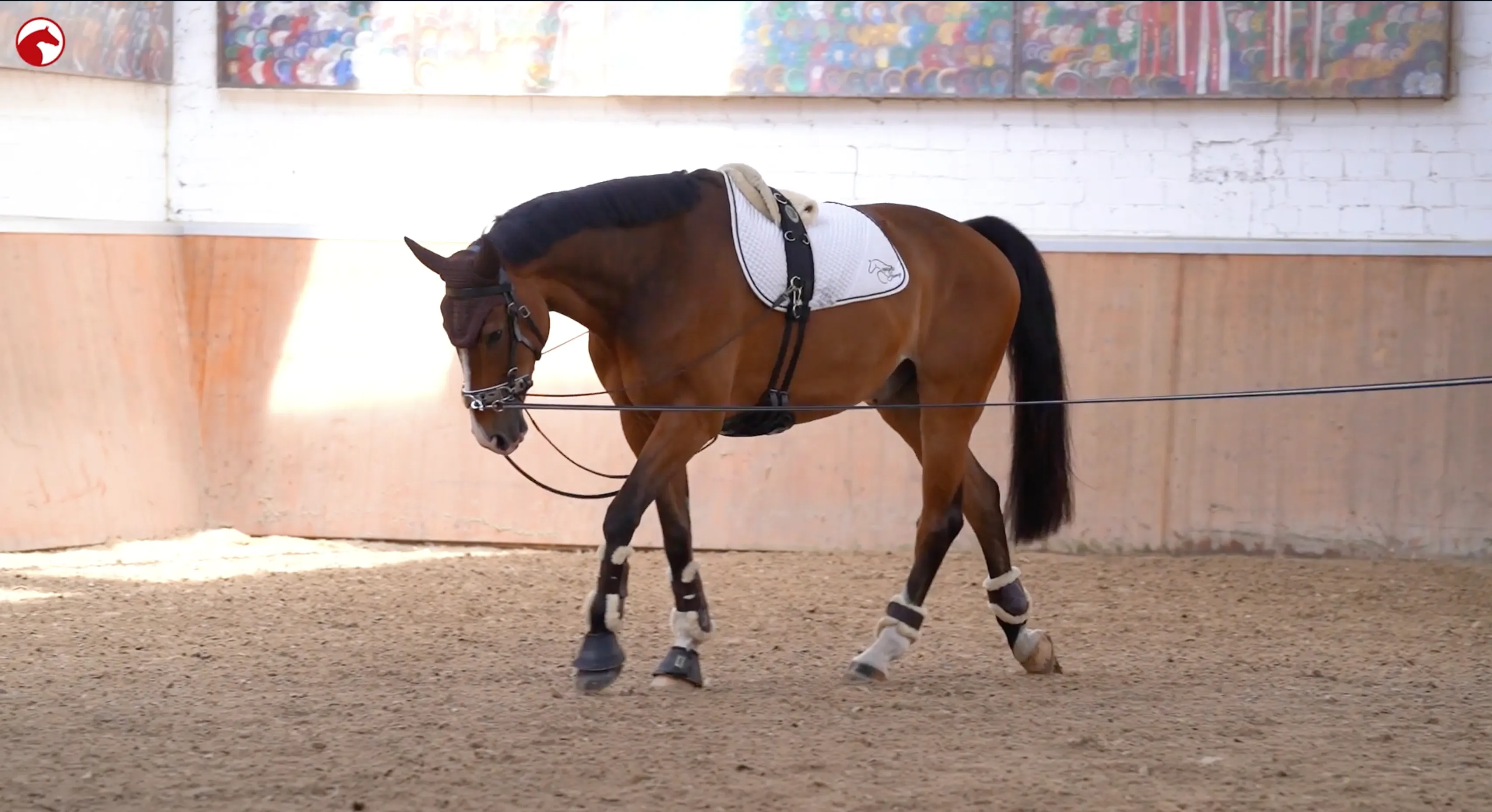
There are many ways to gymnasticize a horse from the ground—whether through lunging, double lunging, or in-hand work.
Lunging for Gymnastic Development
- Incorporate transitions: Just like under saddle, transitions between walk, trot, and canter help improve suppleness and carrying power
- Double lunge work: This method specifically enhances bend, engagement of the hindquarters, and collection
- Adjust circle size: Gradually decrease and increase the circle, ensuring the horse maintains rhythm and tempo without falling inward
Pole Work on the Lunge
- Multiple trot poles in a row improve coordination and body awareness
- Single poles placed at 12, 3, 6, and 9 o’clock positions encourage precision, focus, and correct foot placement
➡️ Video Tip: Holistic Training – Collection Exercises on the Lunge
Collection doesn’t start under saddle! Lungeing expert Lars Hansen demonstrates how to support your horse from the ground with targeted exercises to improve muscle development, balance, and suppleness. Learn how to effectively activate the hindquarters and build a strong foundation for advanced work.

In-Hand Gymnastic Training for Horses
- Variations in walk tempo: Promote suppleness and refined communication
- Circles and turns: Can also be incorporated at the trot around the handler
- Transitions between walk, trot, halt, and rein-back: Improve balance and coordination
- Lateral movements: Encourage hindquarter engagement and enhance flexibility
📖 Reading Tip: Groundwork with Horses – Trust, Communication & Gymnastic Training
Groundwork strengthens the bond between horse and handler, improves communication, and provides a valuable addition to ridden work. Discover which exercises are most effective, how to gymnasticize your horse, and why groundwork is an essential part of training.
Out into Nature – Training in the Open
There are also many ways to gymnasticize your horse outdoors, whether ridden or in-hand:
- Uphill work: Excellent for hindquarter strength, muscle development, and body awareness
- Riding over natural obstacles like branches on the ground: Improves coordination, encourages the horse to lift its legs, and activates core and back muscles
- Water training (aquatrainer): Gentle on the joints, improves body awareness, increases effort, and supports muscle development
- Treadmill training: Allows controlled variation in intensity and supports targeted conditioning
5 Effective Gymnastic Exercises for Horses
Gymnastic training is essential for improving your horse’s mobility, strength, and balance. Here are five effective exercises you can integrate into your training routine:
Lunging – Strengthening Back and Core Muscles
Lunging allows you to train your horse’s muscles effectively without the additional weight of a rider. There are many variations to make lunging sessions diverse and engaging, while promoting optimal gymnastic development.
➡️ Video Tip: Gymnastic Training for Back and Core Muscles
Lunging is an effective way to build muscle without rider influence. In this video, learn which exercises are best suited to strengthen your horse’s back and abdominal muscles and support healthy, balanced training.

Walk Work – The Ultimate Discipline of Gymnastic Training
The walk is the most versatile gait when it comes to gymnastic training for horses. It allows you to incorporate a wide variety of exercises to improve mobility, suppleness, and overall fitness. It is also ideal for assessing your horse’s condition and responsiveness.
In our video, we show you the best exercises to enhance your horse’s flexibility and movement quality.
➡️ Video Tip: Walk Work – Improving Suppleness and Responsiveness
Effective walk work is essential, especially in Working Equitation. Britta Rasche-Merkt demonstrates how to systematically improve the walk to promote suppleness and gymnastic development. Learn why correct walk work forms the foundation for all further training.

Groundwork – Gymnastic Training Without Rider Weight
Gymnastic training is not only effective under saddle but also highly valuable from the ground. Every rider—whether beginner or professional—should regularly include groundwork exercises in their training routine. This not only improves the horse’s physical fitness, but also strengthens the partnership, trust, and communication between horse and rider.
In our video, Bernadette Brune demonstrates which exercises are particularly effective for gymnastic development and relaxation.
➡️ Video Tip: The ABC for Every Horse – Calmness and Gymnastic Training
Basic training starts on the ground. Bernadette Brune presents five essential groundwork exercises that every horse should master. The focus is on body language, respect, and trust. Whether for leisure or sport horses, these exercises help every horse become confident, relaxed, and well-prepared for everyday situations.
.webp)
Basic Exercises for Strength and Coordination
Coordination is a key factor in gymnastic training for horses. A horse with good coordination can use its body more effectively, making it more agile, attentive, and balanced. Even simple pole work and cavaletti exercises can help strengthen your horse and improve coordination.
But how should you structure these exercises effectively? In our training video, you’ll learn how to optimize coordination training and integrate it into your routine in a targeted way.
➡️ Video Tip: Strength & Coordination – Essential Exercises for Young and Older Horses!
Gymnastic training with Olympic champion Ludger Beerbaum focuses on strength, coordination, and targeted muscle development. These exercises are easy to integrate into everyday training and help horses become more responsive and supple. A special highlight: Ludger comments on his own riding and shares valuable tips for effective, practical training.

Transitions, Lateral Movements & Arena Figures – Versatile Gymnastic Training
Transitions, lateral movements, and arena figures not only help to loosen up your horse, but also provide targeted gymnastic training. A well-known exercise is riding serpentines, which can be varied creatively.
For example, you can ride three loops in trot, halt at X, ask for rein-back, and then move off into trot again. There are countless ways to integrate gymnastic exercises into your daily training routine.
Together with Christoph Hess, we have summarized some of the most effective methods for you.
➡️ Video Tip: Effective Gymnastic Training – Improve Collection in Canter!
With targeted transitions, lateral work, and bending exercises, this 7-year-old mare becomes more supple and willing to collect. A special highlight: rider Anni shares her perspective from the saddle and explains how these exercises directly improve the rideability and feel of the horse.

Gymnastic Training for Horses: Summary
Gymnastic training is an essential component of horse training, accessible to every rider—regardless of discipline or training approach. It plays a key role in improving the horse’s health, fitness, and overall well-being by strengthening muscles, enhancing mobility, and promoting suppleness.
Whether you focus on groundwork, incorporate dressage or jumping exercises, or train your horse outdoors, gymnastic work can be integrated into any daily routine.
A well-gymnasticized horse moves relaxed and supple, shows active hindquarter engagement, and is able to carry itself with ease. This not only improves rideability but is also crucial for the horse’s long-term soundness. Through targeted training, varied exercises, and regular breaks, the horse remains motivated and willing to perform.
It is equally important that the rider stays relaxed and focused, ensuring clear communication with the horse. Effective gymnastic training begins with a proper warm-up, preparing both the horse’s body and mind for the work ahead. By combining lunging, walk work, groundwork, and transitions, each rider can tailor the training to their horse’s individual needs.
Ultimately, a well-balanced approach—combined with proper nutrition and care—leads to a healthy, athletic, and content horse, creating the best foundation for a long, active, and harmonious partnership.
Gymnastic Training for Horses: Key Questions & Answers
How can I gymnasticize my horse?
To effectively gymnasticize your horse, regular and structured training is essential. This includes exercises that improve both physical condition and mental focus.
Effective exercises include:
- Lateral movements such as shoulder-in and travers, which improve flexibility and balance
- Arena figures like circles and voltes to enhance suppleness and coordination
- Lunging and groundwork to train the horse without rider weight
- Targeted exercises to strengthen the back muscles and improve relaxation (losgelassenheit)
Always ensure correct execution and appropriate workload. Consistency, variety, and patience are key to long-term progress.
How do I activate my horse’s hindquarters?
Activating the hindquarters is essential for proper movement and collection. The horse must be correctly on the aids:
- Use a balanced seat with slight weight emphasis on the inside seat bone
- Apply active leg aids to encourage engagement
- Incorporate exercises such as leg-yield, travers, and transitions
- Use lunging and groundwork to build hindquarter strength
A correct balance between forward impulsion and collection is crucial to develop a healthy movement pattern.
What does gymnastic riding mean?
The goal of gymnastic riding is to train the horse in a way that allows it to carry the rider correctly without strain on the musculoskeletal system.
This requires:
- Even distribution of weight on the hind legs
- Alternating load-bearing to support the combined center of gravity of horse and rider
- Development of strength, balance, and self-carriage
Proper gymnastic training ensures that the horse remains sound, healthy, and capable of performing over the long term.
You might also like