.webp)
Lunging Made Easy: How to Lunge Your Horse Correctly
This article provides a comprehensive guide to **lunging horses**. Learn how to lunge your horse correctly, choose the right equipment, avoid common mistakes, and use clear aids to keep training effective and safe. Practical tips on circle size, whip handling, voice aids, transitions, and more will help you make lunging a valuable part of your horse’s training routine.
Table of Contents
Purpose of Lunging
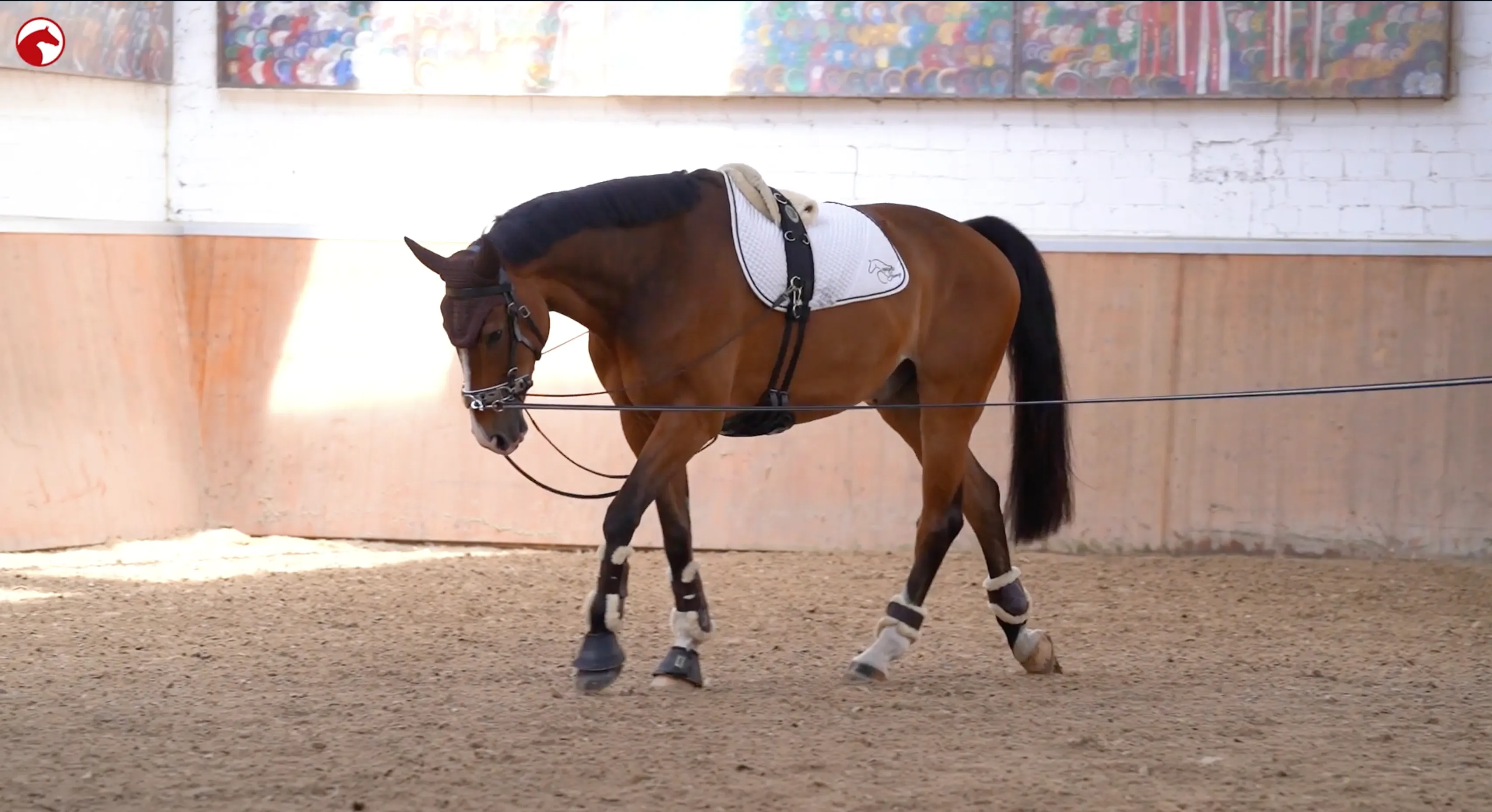
Lunging a horse can be used for many goals: preparing young horses for riding, encouraging consistent movement without a rider, and improving rhythm (takt), balance, contact (anlehnung), suppleness, and bend. It also supports muscle development, adds variety for horse and rider, and can help with training correction in horses with challenges. Lunging is also useful for preparing a horse for seat training, and it can be incorporated before riding or during a careful return to work after illness.
➡️ Videotipp: Effective Lunging – How to Structure Your Training!
Lunging is more than just exercise on the lunge line. But how do you build a session properly? Lunge trainer Lars Hansen explains how a structured routine with warm-up, focused work, and cool-down supports effective gymnastic development—watch now!

Prerequisites for Correct Lunging
For lunging to be effective and beneficial for your horse, a few key prerequisites should be in place:
- An enclosed area: For the first lunging sessions, a safely fenced arena or round pen is essential so you can work securely and prevent the horse from leaving the working space.
- Basic groundwork skills: Ideally, your horse already understands basic groundwork. In some cases, lunging can also be introduced alongside groundwork as a supportive training step.
- Preparatory free schooling: It can be helpful to let your horse move at liberty before lunging—possibly with the support of a helper. This allows the horse to learn important cues such as go forward, halt, and change direction before working on the lunge. Free schooling should only be done in a sufficiently large, safely fenced area.
- Suitable equipment: Lunging equipment must fit well and match the purpose of the session (young horse basics, gymnastic work, rehab, etc.).
- Experience of handler and horse: The experience of both horse and lunger matters. The less experienced the horse, the more experienced the handler should be—and vice versa.
The Lunging Circle
Footing quality and circle size are crucial for safe, horse-friendly lunging:
- Footing: The surface should be stable, grippy, and slightly springy. It must not be too deep, because overly soft/deep footing can negatively affect movement and strain the musculoskeletal system.
- Circle diameter: Commonly, horses are lunged on a circle of 14 to 20 meters in diameter. Adjust the circle size to the horse’s training level and the intended task/gait.
- Choosing the right circle size:
- A circle that’s too large can make it hard to reach the horse effectively with the lunge whip, which may reduce control.
- A circle that’s too small can make the horse rush and increases strain on joints and soft tissue. Achieving a relaxed bend and correct neck posture is also harder on a very small circle.
Selecting an appropriate surface and adjusting the circle size to your horse are therefore essential to keep lunging effective and gentle.
Lunging Equipment
The Halter
A halter must be chosen carefully for comfort and safety. A well-fitting halter should not be too large or loose, otherwise it can slip and rotate around the horse’s head. Different types have different effects:
- Wide or padded halters are softer, distribute pressure more evenly, and can improve comfort.
- Narrow halters or rope halters act more precisely on a smaller surface area and can feel more “direct.”
The best halter depends on your horse and your training goal—but correct fit and comfort are always non-negotiable.
The Cavesson
A cavesson is often ideal for lunging, but only if it fits perfectly and is used correctly. A key feature is the throatlash, which helps keep the cheekpiece away from the horse’s eye—improving comfort and safety by avoiding pressure near the eye.
Most cavessons have three rings on the noseband. These allow you to attach the lunge line either to the inside ring or to the ring on the top of the nose, depending on the training situation. It’s important not to use heavy clips or attachments on the bridge of the nose.
Fit is especially important: the cavesson should be buckled high enough so the noseband does not sit too low on the narrowing nasal bone. A correctly fitted cavesson supports clear communication and safe lunging.
The Lunge Line
When choosing a lunge line, consider:
- Grip and feel: It should sit securely in your hand for precise, controlled aids.
- Length: A standard lunge line is usually around 8 meters, allowing you to use a full circle while keeping a manageable tail end in hand.
- No twisting: The line should not twist easily, as this can interfere with communication.
- Weight: Avoid overly heavy lines for better handling.
- Attachment: Some lunge lines use a buckle loop instead of a clip, which allows a more individualized setup.
- Swivel: A swivel at the attachment end is debated—helpful for untwisting, but it can also encourage the line to twist on its own. This often comes down to personal preference.
A high-quality lunge line is essential for smooth, consistent communication.
The Lunge Whip
A lunge whip should:
- Be light enough to carry comfortably in one hand for longer periods
- Be the right length (including lash) so you can reach the horse based on your circle size
- Have a durable connection between whip and lash
- If made of two pieces, the sections should connect securely
- Telescopic lunge whips can be a practical option because they adjust to different horses and training environments
The right whip supports effective control while keeping both handler and horse safe.
The Handler (Lunger)
As the lunger, you play the key role in safe, effective sessions:
- Wear sturdy footwear for secure footing
- Use grippy gloves to protect your hands and maintain control of the line and whip
- Choose practical clothing that doesn’t create hazards (avoid loose items)
- Keep outerwear closed and secure
- Tie back long hair to prevent accidents
Principles of Lunging
➡️ Videotipp: Fine Aids Despite the Distance – The Basics of Lunging
Clear communication between horse and handler is essential on the lunge. Lunge trainer Lars Hansen explains how consistent, precise aids work even at a distance—and how to guide your horse with subtle signals, building a valuable foundation for in-hand work and riding.

- Lunging, like any training session, is structured into three phases: the warm-up phase, the working phase, and the cool-down phase.
- It’s important to include purposeful changes of rein while lunging to ensure the training remains even and balanced on both sides.
- During lunging, you should always have a clear training goal in mind to achieve effective progress.
- The lunge line must always be gathered neatly in the hand and should never drag on the ground, to ensure safe handling and control of your horse.
- The lunge whip should not be left on the ground to avoid distractions or interference.
- As the lunger, it’s your responsibility to observe your horse closely throughout the entire session, so you can spot any signs of discomfort or irregularities early and respond appropriately.
Giving Aids in Lunge Work
Your Position
Choosing your position with intention is essential during lunge work. You should always be aware of how your current position influences your horse. Depending on where you stand, your body position can either encourage your horse forward or have a restraining effect.
In the basic position, you stand slightly behind your horse’s shoulder. This position becomes driving when you move more toward the hindquarters. It becomes restraining when you move more toward the head.
Ideally, you should turn with your horse in small steps on the smallest possible circle while staying as close as possible to the center of the lunge circle. On the left rein, you pivot around your left foot; on the right rein, you rotate around your right foot.
Constantly walking along with your horse or stepping backwards while lunging is not desirable. The aim should always be a smooth forward rhythm and clear communication between horse and handler.
During lunging, your horse moves on the circle line and is framed by your aids. On one side, there is the lunge line, which can also have a restraining effect. On the other side, there is the lunge whip, which acts as a driving aid.
When working on the right rein, the lunge line runs from your horse’s head to your right hand, while you carry the whip in your left hand.
Voice Aids
Your voice is one of the most important aids when communicating with your horse. It can be used in many different ways and has a significant impact on your horse’s behavior. This is not only about the words you choose, but also about your tone of voice and emphasis.
Words can be used as commands, especially for transitions and half-halts. In addition, your voice has an independent effect beyond the actual words. It can sound encouraging, calming, praising, or attention-grabbing.
At the same time, it is important to keep your voice at an appropriate volume. Talking too much can distract your horse and make it dull to your aids. Communication during lunging should therefore always be deliberate, precise, and effective.
Using the Lunge Whip Correctly
There are several important points to keep in mind when handling the lunge whip.
The lunge whip is an essential part of your equipment. Without it, lunging is like riding without driving aids — your communication options are limited.
Never forget: the whip is not a tool for punishing your horse. Its purpose is to give clear, understandable signals that your horse can easily interpret.
Handling the whip correctly takes practice. You need to develop feel and precision so you can use it in a subtle and targeted way.
The whip acts as a visual extension of your driving aids and can be directed toward specific parts of the horse, such as the hocks, point of buttock, shoulder, or ribcage.
Timing is crucial. Meaningful and effective whip use depends on applying it at the right moment, with the right amount of pressure, and in the right place.
The loops are transferred evenly with the hand holding the lunge whip into the hand holding the lunge line. They should lie neatly on top of each other and be easy to release from the hand at any time.
Depending on whether you are lunging on the left rein or the right rein, you hold the longe in your left or right hand accordingly.
The lunge line determines the circle size and, depending on your training goal, should either have a slight slack or maintain light contact. Keep your lunge hand upright so that the back of your hand, your forearm, and the lunge line form a straight line.
To influence your horse, use principles similar to riding, including receiving and giving aids. If you want to send your horse farther out on the circle, use the whip rather than the lunge line, and avoid constantly pulling on the line.
Content of Lunge Work
Working on the lunge offers a wide range of training possibilities and depends heavily on your individual goals and your horse’s level of education and conditioning.
Possible elements of lunge work include:
Standing still
Walk work
Trot work
Canter work
Transitions to halt
Transitions between gaits
Changes of rein
Making circles smaller and larger
Shifting the circle line
Variations in tempo within one gait
Pole work
Lunge work can therefore be used in many different ways to meet your horse’s individual needs and support specific training goals.
➡️ Video Tip: Holistic Training – Collection Exercises on the Lunge
Collection does not start only under saddle. Lungeing expert Lars Hansen shows how you can support your horse from the ground with targeted exercises to improve muscle development, balance, and suppleness. Learn what matters most in collected work on the lunge and how to activate your horse’s hindquarters more effectively.

Starting Lunge Work
When preparing your horse for lunge work, make sure the lunge line is already attached on the side where you want to begin. The line should also be correctly gathered in your hand. As you lead your horse to the lunge circle, hold the whip in the hand facing away from the horse. The whip should point away from the horse, and the lash can either be held securely or wrapped around the whip. Start lunging on a small circle and gradually make the circle larger until your horse is moving on the desired line. Make sure you keep enough distance from your horse’s hindquarters when asking it to move forward on the lunge.
Making the Circle Smaller or Larger in Lunge Work
Enlarging the circle: To make the circle bigger, slowly lengthen the lunge line by allowing it to slide gradually through your slightly open hand. You should still maintain a light connection to your horse so that the horse can take the line from your hand smoothly. Never let entire loops drop out of your hand, as this would interrupt the contact and reduce control.
Shortening the lunge line: To make the circle smaller, shorten the line by reaching in front of the lunge hand with the hand holding the whip and slowly drawing the line back. The loops are then placed evenly into the lunge hand with the hand holding the whip, so they lie neatly on top of each other.
Changing Rein in Lunge Work
These are the basic rules for changing rein while lunging:
The lunge line must be neatly organized at all times before, during, and after the rein change.
The line must be prepared for the new rein before making the change.
The whip should be changed either behind your back or over your head, never toward your horse.
The type of rein change should match your horse’s training level to avoid confusion.
If the lunge line is attached to the side ring of a cavesson or halter, it must always be re-buckled or reattached correctly for the new side.
Turn on the Forehand
Transition to a slower pace on the third track of the circle.
Step gradually closer to your horse while shortening the line as described earlier.
Move to the outside of your horse.
Point the lunge whip toward the hindquarters.
Ask for a turn on the forehand.
Then begin lunging again.
Crossing Through the Circle
Gather the lunge line correctly.
Lead your horse into the center of the circle.
Then send it back out onto the circle line on the new rein.
Transitioning on the Circle Line
Gather the lunge line correctly and walk toward your horse.
Lead your horse to the center of the circle.
From there, begin lunging again on the new rein.
The Half-Volte or Reverse Turn
Shorten the lunge line so that your horse steps slightly toward the center of the circle.
Use a combination of repositioning yourself, the lunge line, body language, and the lunge whip to guide your horse through a reverse turn onto the new rein.
For every rein change, make sure the lunge line is correctly organized:
The lunge line should always be gathered properly for either the left rein or the right rein.
The loops should be able to slide smoothly from the lunge hand toward the whip hand so that no tangles or knots occur.
Before a rein change, the line must be prepared for the new side by transferring it into the other hand and placing it into the new lunge hand.
If the line has only been partially let out before the rein change, the loops should be passed one by one into the new lunge hand so they can continue to slide out neatly.
Transitions
Transitions between gaits are extremely important in lunging. They help improve your horse’s attention, relaxation, rhythm, balance, and suppleness. In addition, upward transitions increase hindquarter activity and impulsion. Especially valuable are transitions from halt to trot or from walk to canter, as long as the horse remains relaxed.
To ask for an upward transition from a lower gait to a higher gait, you can use:
Clear voice commands
Encouraging vocal signals
A slight shift of your own position toward the horse’s hindquarters
A change in your body language
Raising the whip
Targeted use of the whip
If you want a downward transition from a higher gait to a lower gait, the following aids can be used:
Clear voice commands
A slight shift of your own position toward the horse’s head
Lowering the whip
Calming vocal signals
These aids allow you to influence your horse’s gaits precisely and perform smooth, well-balanced transitions.
Lunging Horses: A Summary
Lunging plays an important role in both horse training and long-term soundness. It supports muscle development, improves rhythm, balance, and mobility, prepares young horses for ridden work, and can also be used in rehabilitation after illness or injury. Correct lunge training should always be adapted to the individual horse, its needs, and its current level of training.
Key factors for effective lunging include a safely enclosed arena, suitable equipment such as a cavesson for refined communication, and a well-sized lunge circle with secure, grippy footing. Depending on the training goal, a lunge session should usually last around 20 to 30 minutes to avoid fatigue and overloading, especially in young or untrained horses. Using the right equipment, including a well-fitted lunge line and a proper lunge whip, is essential for clear communication and correct support.
The person on the lunge also plays a crucial role and should have the necessary knowledge and experience to structure the training correctly through the warm-up phase, working phase, and cool-down phase. Mistakes such as unclear aids, unsuitable equipment, or lack of control over the horse should be avoided in order to get the full benefit from lunge training and create a solid foundation for muscle building.
By now, you should already have learned a great deal about correct lunging. Here you can find out how to build a meaningful and effective lunge training program for your horse:
Lunging a Horse: The Most Important Questions and Answers
How long should you lunge a horse for muscle building?
For muscle development, it is important to keep a lunging session to around 20 to 30 minutes. This is usually enough time to train the horse effectively without overloading its muscles and joints. Young or untrained horses should start with shorter sessions and build up gradually.
Why should you not lunge a horse in a halter?
A simple halter offers little to no control over the horse’s flexion, bend, and straightness. It can also create pressure points. During lunge work, clear and refined aids are essential to help the horse stay balanced and work correctly. For this reason, purpose-designed equipment such as a cavesson is usually the better choice.
How long can you lunge a horse?
As a general rule, a lunging session should not exceed 30 minutes. Longer sessions can lead to fatigue, poor posture, and unnecessary strain. This is especially true in more demanding work with a lot of canter or frequent transitions, where the workload should be adjusted and the horse should be given enough breaks.
Why do people lunge with a cavesson?
A cavesson allows refined and precise communication with the horse’s head without putting pressure on the bit or directly stressing the mouth. It offers better control over flexion and bend, which is essential for effective training, correct posture, and muscle development. It also reduces the risk of injury in the sensitive mouth area.
Why should you not lunge a horse in a bridle?
Lunging in a bridle can place considerable pressure on the horse’s sensitive mouth, especially if the horse pulls on the lunge line or leans heavily into the bit. In addition, direct communication through the lunge line can become less clear, which may lead to confusion, tension, and stress.
Can you lunge a horse in a rope halter?
A rope halter can, in principle, be used for lunging, but it offers less precise control than a cavesson. It may be suitable for horses that already understand light aids and are experienced in lunge work. Even so, it is important to make sure the rope halter fits correctly to avoid pressure points or injury.
How often should you lunge a young horse?
A young horse should generally be lunged no more than two to three times per week so the joints, tendons, and muscles are not overworked. Sessions should be kept short, especially at the beginning, with around 10 to 15 minutes being a sensible starting point.
Can you lunge a horse in a regular halter?
Technically, yes, but it is not ideal. A regular halter gives limited control and may create pressure points. For more precise aids and more effective training, a cavesson or a properly fitted lunging halter is the better option.
When should you start lunging a young horse?
You can usually begin lunging a young horse at around 2.5 to 3 years of age, provided the horse is physically and mentally ready. The introduction should be gradual and carried out in short sessions so the young horse can learn calmly and without stress.
You might also like