The diversity of driving
Equestrian driving has experienced steady growth among equestrians for decades. The challenge of building communication and trust between horse and driver is different from riding. And the variety of disciplines makes driving increasingly popular.
Table of Contents
Driving is not as widespread as riding, but it has experienced steady growth in recent decades. Driving is a form of equestrian sport in which horses pull a carriage or wagon. Horses harnessed to a carriage can be seen not only in leisure driving and competitive sport, but also in commercial carriage rides, which are very popular for various occasions. You will discover the diversity of driving below.
The History of Driving
Horses were harnessed to wagons as early as a thousand years ago. They were needed for transporting loads, in agriculture and forestry, or in war to pull chariots. Horses were also harnessed for chariot races to entertain the public in the times of the Greeks and Romans.
With mechanization during the Industrial Revolution, horse-drawn vehicles gradually lost their importance. Instead, carriage driving shifted from a practical necessity to a leisure activity and eventually to a sport. The first driving test was held in 1925 at one of the most prestigious competitions in Aachen. In 1969, driving was officially recognized by the Fédération Équestre Internationale (FEI) as a discipline in international equestrian sport. Just a few years later, in 1972, the first World Championship in four-in-hand driving took place.
The pioneer of driving sport is Benno von Achenbach. To this day, German competitions organized by the Deutsche Reiterliche Vereinigung (FN) require the Achenbach driving system. Anyone who does not drive according to Achenbach receives a penalty of 0.5 points.
Achenbach’s system remains the foundation of European driving instruction and forms the basis for training driving horses. There are seven principles of the Achenbach system:
- Correct driving includes Achenbach reins, a whip, and a fixed splinter bar (no swinging bar).
- Correct four-in-hand and multiple-horse driving is based on equally correct single- and pair-horse driving.
- The reins are held in the left hand. The driver must always keep the right hand free for greeting, braking, using the whip, etc.
- Turns are initiated exclusively by yielding the outside reins, preceded by shortening the pace.
- Only the vertical position of the fists allows a turn through rotation of the wrists.
- Since the driver sits on the right side of the box seat, right and left turns are driven differently.
- Letting the reins slide through the hands is dangerous and prohibited, as it prevents correct driving.
Basic Knowledge and Equipment in Driving
Driving involves a great deal of equipment, expense, and effort. Unlike riding, it is not just a matter of one horse with saddle and bridle. In some cases, several horses belong to a turnout, and the harness and carriage must also be accommodated. It is especially important that all driving equipment is safe and roadworthy at all times in order to prevent accidents.
Types of Carriages: What Types Are There?
Due to more than a thousand years of development of carriages and wagons, there is now a wide variety of carriage types. The main distinction is made between single-axle and double-axle carriages:
Single-axle carriages:
- Sulky (harness racing): The driver sits directly behind the horse; there is space for only one driver.
- Gig: Similar to a sulky, but with space for two people.
- Quadriga: A Roman chariot.
- Dog cart: A single-horse carriage with a cover.
Double-axle carriages:
- Dressage carriage: A carriage in keeping with tradition but incorporating modern technology. There are various forms, e.g. hunting carriage, phaeton, wagonette, etc., for competition sport. Dressage carriages can be driven single or pair.
- Marathon carriage: For the cross-country phase at driving competitions with fast turns, made of robust lightweight metal. One or more grooms stand on the back to keep the carriage balanced by shifting their weight.
- Victoria: A historic, enclosed carriage or carriage with a folding half-top; can be driven with two to four horses.
- Landau: A carriage body with two opposing benches and a folding leather roof. Usually driven as a pair for special occasions, e.g. weddings or for carrying distinguished personalities.
- Kremser: A covered wagon pulled by two draft horses. It accommodates 12 to 30 people. Kremser rides take place at larger events such as Ascension Day or sightseeing tours for tourists.
The Foundation of Carriage Driving: Rein Handling
According to Achenbach, correct driving includes proper rein handling. The basics must be firmly established, because the more horses there are in the turnout, the more complex rein handling becomes. The driver must therefore know instinctively how to hold the reins. There are three positions: the working position and the dressage or active position are based on the basic position. For the sake of simplicity, the following descriptions focus on two reins, i.e. single-horse driving.
Basic Position
In the basic position, both reins are held in the left hand:
The left rein lies over the index finger, with the thumb slightly open. The right rein is passed between the middle and ring fingers. The left hand is held as a vertical fist in front of the center of the upper body. The whip is held in the right hand. The ends of the reins hang outward over the left thigh. This position must not be abandoned; it forms the basis for the working and dressage positions.
Working Position
This position serves to relieve the left hand and to shorten or lengthen the reins, for example in turns or when changing pace.The basic position of the left hand remains unchanged. The right hand now reaches in front of the left hand. With the three lower fingers, the right hand takes the right rein; with the thumb and index finger, it takes up the left rein.It is important that the reins do not simply slide through the right hand. They must be taken up or released by the right hand as described. Only in this way is correct driving possible.
Active or Dressage Position
From the working position, the right hand pulls the right rein out of the left hand. Both hands are now held upright next to each other.
What Are the Characteristics of the Ideal Driving Horse?
In principle, any horse can be broken to harness, and any riding horse can be trained to become a carriage horse. However, as in riding horse breeding, there are also breeding lines specifically aimed at suitability as driving horses. Breeds commonly and frequently used for driving include Shetland Pony, Friesian horse, Schweres Warmblut, Freiberger, Clydesdale, other draft horse breeds, and trotters.
Ideally, the conformation of a driving horse is rectangular and powerful. A sloping shoulder accommodates the harness well and allows for ground-covering movement of the forehand. This makes the trot in front of the carriage particularly impressive. Furthermore, a carriage horse should have elastic, expressive basic gaits so that it can pull the vehicle effortlessly and present an attractive picture, especially in competition.
The temperament and character of a driving horse are equally important: carriage horses must be steady-nerved, even-tempered, and calm so as not to be startled by their surroundings. At the same time, they should be willing to work, attentive, and possess a controllable forward drive.
Some of these qualities can be developed through systematic training. Nevertheless, it is generally helpful if the horse is naturally not overly spooky in order to avoid accidents.
During training, the prospective driving horse develops greater strength and balance, as well as suppleness and the ability to respond finely and precisely to the aids.
The Most Important Elements in Training a Driving Horse
Driving can become a dangerous matter if the horse has not been properly prepared. If it is startled, jumps sideways, or bolts, this can have serious consequences for both horse and driver with a carriage in tow. In addition to solid training for both horse and driver, clear communication between them is essential.
Training a carriage horse must not be a crash course; it takes at least two to three months. A shorter training period should not be aimed for, as this would otherwise lead to overtaxing the horse. For young horses that have never been worked before, neither from the ground nor under saddle, correspondingly more time should be planned for breaking to harness.
Breaking the Horse to Harness
The training scale applies not only to riding horses, but also to driving and draft horses. The individual elements of the training scale — rhythm, suppleness, contact, impulsion, straightness, and collection — serve as guidelines. Groundwork and dressage therefore provide an excellent foundation for driving, ensuring that the driving horse remains healthy in the long term.
Breaking a horse to harness must be done step by step and adapted to the horse’s pace. Each step builds on the previous one and consolidates progress in a sustainable way.
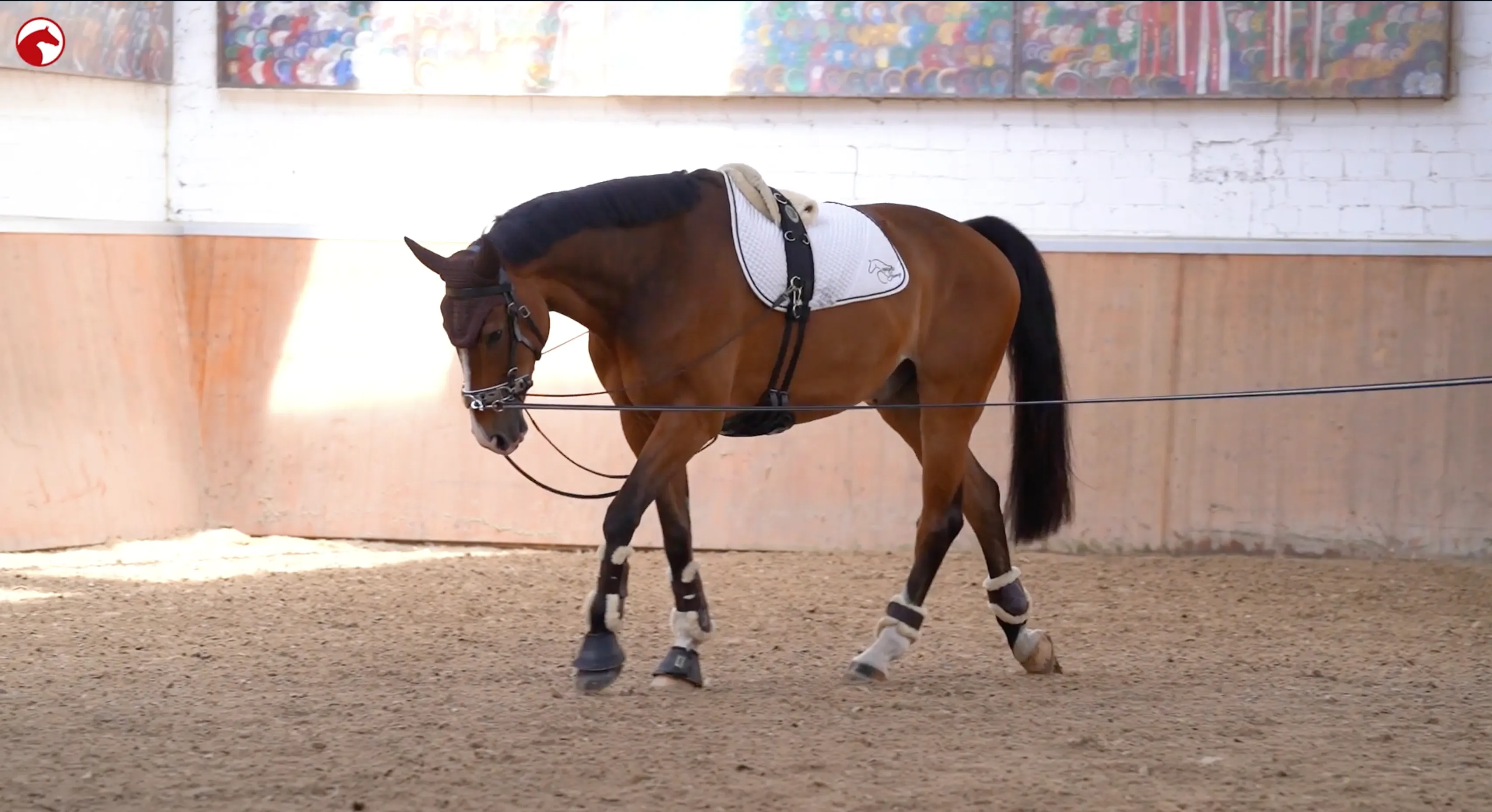
Training begins with work on the double lunge. Here, the horse becomes accustomed to its position in draft and learns the basic aids. Through double-lunge work and extensive groundwork, the horse is gymnasticized and physically prepared for pulling. From the ground, it is taught the basic commands: changes of pace, transitions, turns, halting, and standing quietly.
Once the basics are established, desensitization follows. The horse is familiarized with wearing the harness, with the traces that may slide between its legs, and with environmental noise. Desensitization is indispensable for the reliability of the future driving horse. At this stage, a drag (an object pulled behind the horse) can be introduced, so the horse pulls weight behind it. It must become accustomed not only to the pressure on its chest and shoulders, but also to the dragging noise behind it. This helps prevent it from switching into flight mode.
The third step is the actual hitching. Thanks to the intensive preparation, the horse should now have fewer problems with being harnessed to a vehicle for the first time. It is important that this step is also prepared in detail to avoid careless mistakes. If the horse is startled and panics while only partially harnessed, this can become deeply ingrained in its memory. And bad experiences are difficult to erase or overwrite.
For breaking to harness, a training vehicle with small wheels but a wider track is generally used, as it has very stable balance. Some trainers prefer a light sulky. A second person walking beside the horse is essential and can calm it if necessary. Support from an experienced second horse can also be helpful, as it provides reassurance to the inexperienced horse. However, some trainers prefer single-horse training to pair training, since with a single horse there is no central pole that might irritate an inexperienced horse.
Commands and Signals in Carriage Driving
When driving a carriage, the weight and leg aids primarily used in riding are no longer applicable. Communication between driver and horses must therefore take place through the reins, whip, and voice. In addition, there is the use of the brake. All aids must be given as precisely as possible so that, especially in pair or multiple-horse driving, only the intended horse is addressed. This primarily requires the driver to train themselves and internalize the correct use of the aids.
- Rein aids: There are taking (half-halt) and yielding rein aids. The reins are never jerked or struck.
- Whip aids: These support the voice aids. There are forward-driving, sideways-driving, guarding, collecting, and corrective whip aids. They are always applied from the outside near the girth area and imitate the rider’s leg pressure. Corrective whip aids are used only when absolutely necessary and applied at the shoulder. The whip is never cracked.
- Voice aids: These can have an encouraging or calming effect. A disadvantage with pairs or multiple-horse teams is that all horses respond to them. To avoid confusion, the same signal should always be used for the same command.
- Brake aids: These relieve the horses when driving downhill or when reducing speed. It is important that braking is always preceded by preparatory half-halts on the reins. The brake also secures the carriage when it is parked.
Driving Sport Nationally and Internationally
With the first World Championship for four-in-hand teams in 1972, driving also became firmly established internationally within equestrian sport. Driving competitions are divided into single-horse, pair, and four-in-hand classes. It does not matter whether pony, warmblood, or draft horse teams compete against one another in the respective class. This is a major difference from other equestrian disciplines, where horses are often divided according to size.
Driving competitions are further divided into levels of difficulty or classes ranging from E and A to M and S. The L class is omitted in driving sport.
Disciplines in Driving Sport
The various disciplines demonstrate the great diversity of driving, which is just as varied as riding.
Dressage Driving
In dressage driving, as in ridden dressage, a prescribed test is driven in a driving arena. It consists of arena figures, changes of pace, and transitions. The evaluation focuses primarily on the horse’s gymnastic development and level of training. Clothing, equipment, and the turnout should also be presented in a style-appropriate manner.
Cross-Country Driving or Marathon Phase
The fastest and most spectacular driving test is cross-country driving. The teams must negotiate various natural and artificial obstacles such as bridges, water crossings, and narrow, winding tracks. The total course of 15 to 18 km is divided into three to five sections, which must be completed within a specified time.
The groom (navigator) is indispensable. Standing on the back of the light marathon carriage, they stabilize it in tight turns by shifting their weight.
Obstacle Driving or Cones Driving
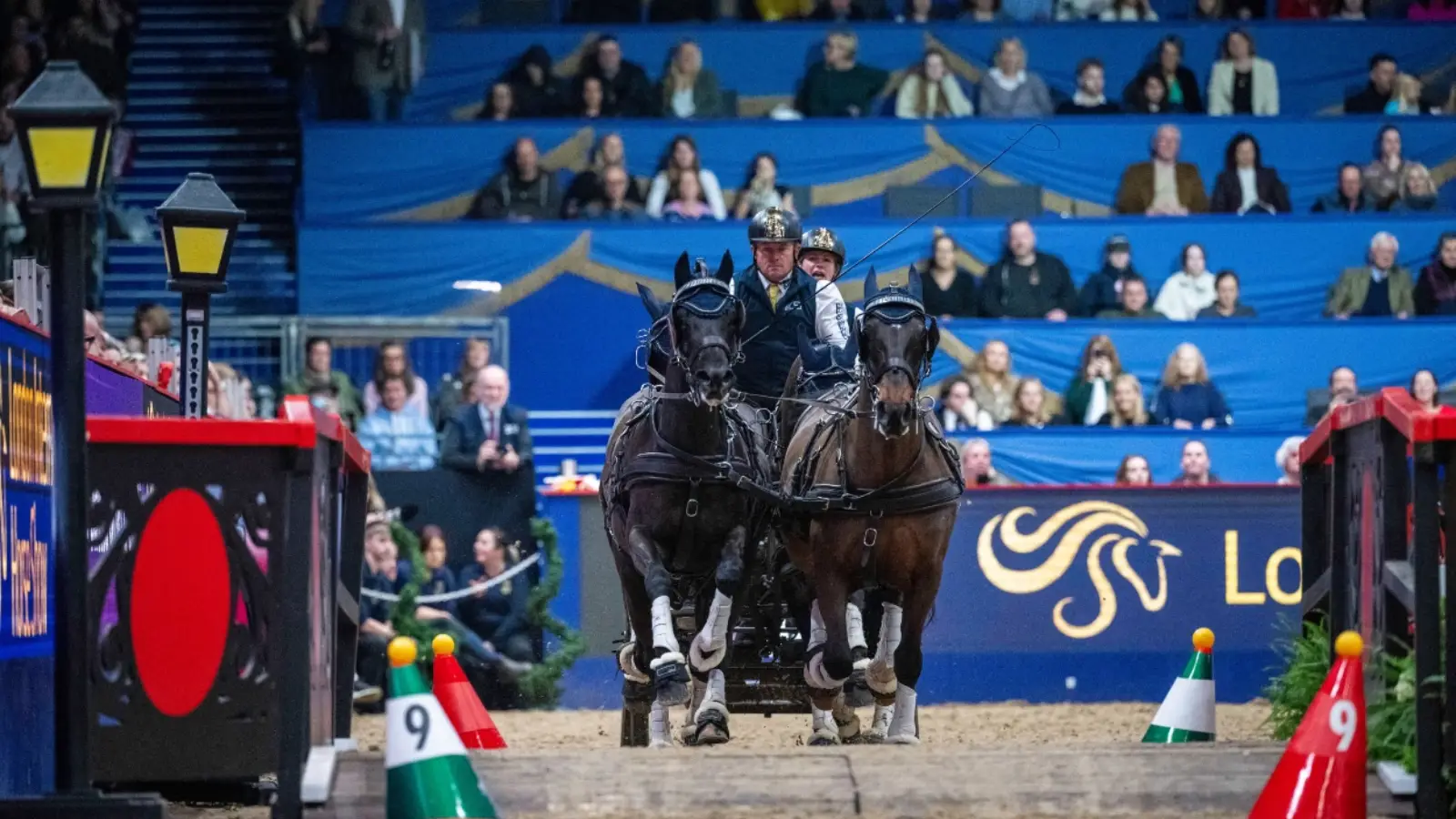
The teams drive through a narrow course of cones topped with balls. They must remain within the prescribed time. Penalty points are given for exceeding the time limit, refusals, or touching the obstacles.
These three driving disciplines can be contested as individual tests or combined.
Endurance Driving
In endurance driving, the total distance must be completed within a set time. Teams cover between 25 and 160 km per day, and multi-day events are also possible. A break is taken every 25 km, during which the horses can recover and undergo veterinary inspection.
Well-Known Names in Driving Sport
Driving has become an integral part of competition sport. The best drivers compete not only at regional level, but also at the German Driving Championships, the Bundeschampionat for German Driving Horses, European Championships, World Championships, and even the Olympic Games. The current national head coach of the German drivers is Karl-Heinz Geiger.
The top drivers are divided into championship, perspective, and junior squads.
Internationally, leading competition drivers include Boyd Exell, Bram Chardon, and Chester Weber.
Chester Weber in interview: How did he get into driving sport and what makes it special for him?

Is a Carriage Driving Licence Mandatory?
All carriage drivers who wish to drive their teams on public roads and paths require a carriage driving licence. A distinction is made between the Carriage Driving Licence A for private individuals and the Carriage Driving Licence B for commercial drivers.
Why Is There a Carriage Driving Licence?
As soon as a team is driven onto public roads, the driver becomes a road user. Similar to a car driving licence, the carriage driving licence ensures that the driver is qualified and competent to drive on public roads. Its primary purpose is accident prevention.
This requirement originated from an initiative prompted by the fact that driving sport, particularly from animal welfare organizations, has been viewed critically. The aim was to create a standardized system in Germany to ensure the professional qualification of carriage drivers. The Deutsche Reiterliche Vereinigung requires that every driver participating in road traffic with a team holds the Carriage Driving Licence A (private). However, the carriage driving licence is not legally mandated nationwide. Nevertheless, it is essential as proof of competence in the event of accidents or insurance claims.
Who Is the Carriage Driving Licence For?
The carriage driving licence is intended for any driver who takes their team onto public roads. This applies to both private individuals (Licence A) and commercial carriage drivers (Licence B).
Private carriage drivers without competitive ambitions must take the test for Licence A. Private drivers who intend to compete, however, require at least the Driving Badge Level 5 for competition sport. Since many of the contents overlap with the qualification for Licence A, the Level 5 badge offers the option of an additional safety module. This avoids having to take the competence examination twice. The Carriage Driving Licence A is valid indefinitely.
Commercial carriage drivers include all those who charge a fee for rides and passenger transport. They must obtain the Carriage Driving Licence B, for which Licence A is a prerequisite. The examination differs by including additional topics such as passenger transport, load securing, driving heavy combinations, and technical requirements. The Carriage Driving Licence B is valid for five years and can be renewed through further training consisting of eight learning units.
Driving Sport: The Most Important Questions and Answers
At what age may a horse be driven?
The driving guidelines recommend harnessing a horse to a carriage only from the age of five. In tests organized by the Deutsche Reiterliche Vereinigung (FN) for driving badges, the horses used are at least five years old; for the carriage driving licence examination, they must be at least four years old.
As with riding, the horse must be physically and mentally mature enough to pull a carriage. Breaking to harness should therefore begin no earlier than two years of age, preferably at three. However, this age recommendation cannot be applied uniformly to all horses. Ponies in particular are late developers and may not be as physically mature as a warmblood of the same age.
If the driving horse is also a young riding horse, breaking to harness should not take place at the same time as backing under saddle. This prevents confusion between new commands. If the horse is primarily intended as a carriage horse, training to harness should come first. Voice commands and habituation to the harness can later be beneficial when starting under saddle.
How long may a driving horse work?
Guidelines recommend how long a driving horse may work at a stretch; however, there is no specific legal regulation. As working animals, carriage horses require both breaks and a daily limit. A driving horse should not work more than nine hours per day and must have a break of at least 30 minutes every four hours. In high temperatures, breaks should be taken in the shade every two hours. The driver must also provide access to water, and roughage must be carried on longer routes.
Commercial drivers record driving and rest times in a logbook, which must be presented during inspections if required.
The actual working duration depends on the horse’s level of training and fitness. Horses must not be worked beyond their limits. For young driving horses, duration and draft weight must be increased gradually.
How can you get started in driving sport – are there courses?
More and more young people are becoming interested in driving; it is no longer reserved for “older gentlemen.” As in riding, driving is well organized in Germany through the Deutsche Reiterliche Vereinigung and a broad network of carriage businesses.
However, driving schools are still less common than riding schools, and students may need to travel some distance. An online search or information from the FN provides access to networks of drivers, carriage businesses, schools, and clubs.
Many carriage businesses offer courses and clinics for various training levels of both driver and horse. Beginners typically learn in a driving school with experienced horses, while those who already own a turnout can seek support from a driving club.
What costs are associated with driving?
Competition driving can be expensive and time-consuming. In addition to the horse and harness, the carriage must also be transported and stored. In some cases, several horses must be transported. Travel to competitions can therefore be complex and costly, especially with overnight stays.
The purchase costs of carriages and harnesses can initially be daunting. Anyone buying a used carriage to reduce costs must ensure it is still roadworthy and safe.
Costs vary depending on the vehicle. A used training carriage can be purchased from around €4,000, while a small pony carriage or gig/sulky may cost around €3,000. New carriages are considerably more expensive.
Harness prices also vary widely. Complete single-horse harnesses are available from around €300 in online equestrian stores, whereas custom-made harnesses from saddleries may cost €2,000 or more.
How many people fit in a carriage?
The number of passengers depends on the type of carriage and must not exceed the designated capacity. A sulky carries only one person, while a covered wagon may accommodate up to 30 people depending on size.
It is important that the total weight of the carriage, including driver and passengers, does not exceed twice the weight of the horse. The carriage alone can weigh between 600 and 1,000 kg. Rolling resistance, gradients, and surface conditions must also be considered. A well-running carriage is easier to pull than one with higher resistance. On smooth, level ground, a horse may even pull up to three times its own weight. The overall situation must always be assessed.
What physical and mental demands does driving place on driver and horse?
The driver is responsible for road safety, beginning with appropriate and intact equipment, proper training of the horse, and the smooth conduct of the drive. The driver must be familiar with traffic regulations and local laws concerning roads and forest or field paths. They must always be fit to drive and not under the influence of alcohol or other substances. Proof of competence requires a Carriage Driving Licence A or B.
The driving horse must be physically capable of pulling the carriage without harm. In addition to draft work, it needs regular free movement to remain balanced. To prevent accidents, the horse should be steady-nerved, calm, and willing to work.
Where can you drive a carriage?
Carriages may generally be driven wherever there are paved paths and roads. However, some routes, such as certain forest tracks, may be closed to horse-drawn vehicles and are marked accordingly. Before setting out, drivers should familiarize themselves with regional regulations and planned routes to avoid conflicts.
Is carriage driving animal cruelty?
Like equestrian sport in general, driving occasionally faces public criticism. When properly practiced, driving is not animal cruelty. Proper practice means that equipment fits correctly, horse and driver are well trained, the horses are healthy and well cared for, and the driver acts responsibly and competently.
There are also guidelines regarding permissible draft weight. Speed must be appropriate. Horses trained according to the training scale have learned to use their bodies correctly, preventing harm from draft work. Regular veterinary and farrier care is also essential.
You might also like