Vaccinations in horses: everything about required vaccinations, vaccination intervals, and side effects
Vaccinations are an important part of preventive healthcare for horses. Learn everything here about horse vaccinations against herpes, tetanus, and influenza, as well as their vaccination intervals.
Table of Contents
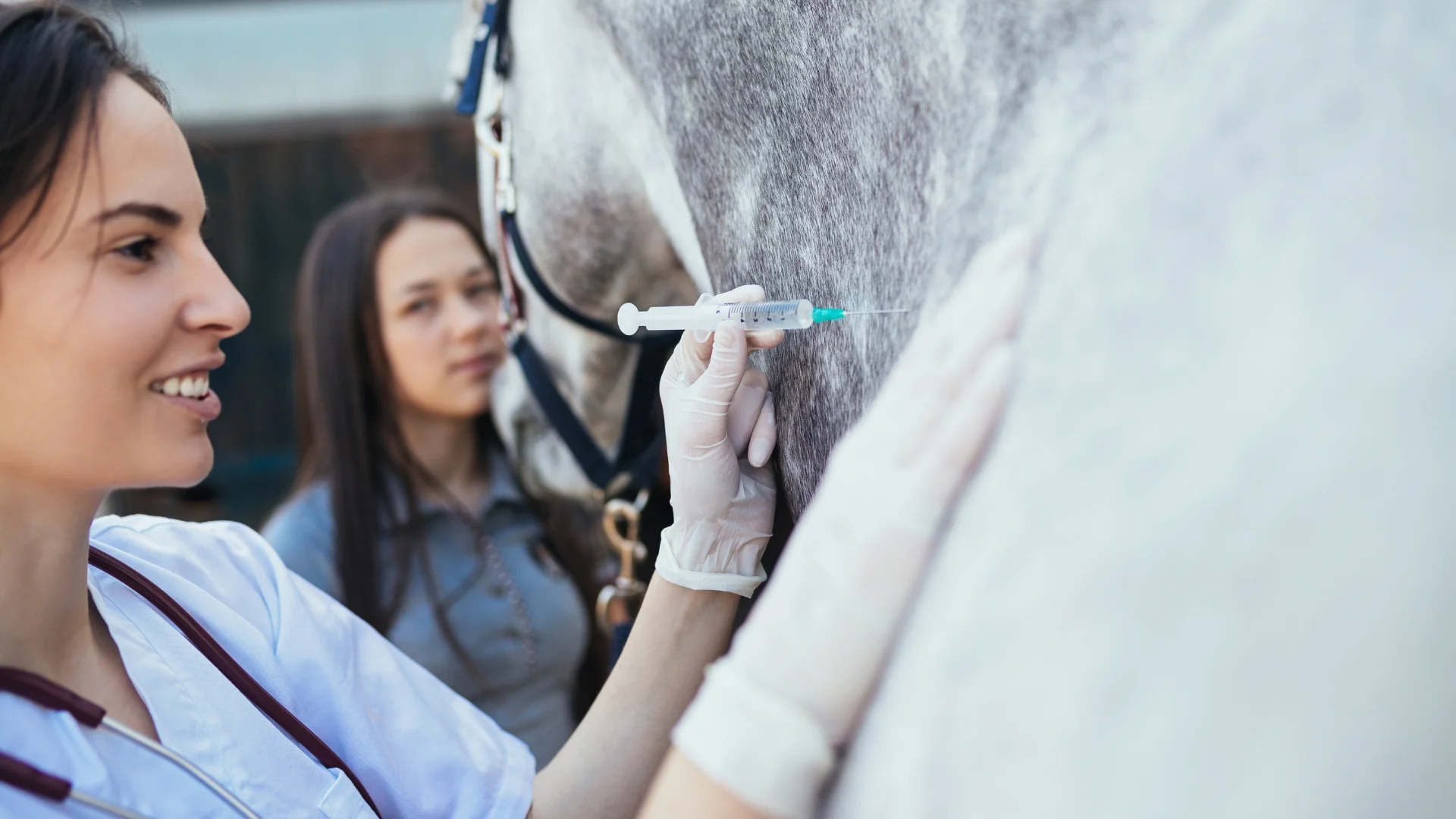
Vaccinating horses is a preventive measure against viruses to avoid infections and disease outbreaks or to reduce their severity. Vaccinations are an essential part of a horse’s healthcare and well-being, helping to prevent flu outbreaks and even fatalities. Here, you will learn which vaccinations are mandatory for horses, which are recommended by the StIKO Vet, and how often horses need to be vaccinated.
Why are vaccinations important for horses?
Vaccinations play a crucial role not only in the health of the individual horse but also in herd immunity, helping to prevent epidemic-like outbreaks of disease. Wherever there is a high risk of infection, preventive measures are necessary to protect both individual horses and the entire group. This is especially important for horses that frequently come into contact with others from different stables, such as competition horses, horses in external training, or trekking horses.
When the immune system encounters pathogens and successfully fights them off, it forms memory cells, known as antibodies. These remember the structure of the viruses and can defend against them more effectively during future infections.
However, the immune system does not always produce sufficient antibodies on its own, which is why it sometimes needs a small stimulus. This is where vaccination comes in:
During vaccination, weakened or inactivated pathogens are injected into the horse, prompting the immune system to produce antibodies. This immune response protects the horse against these pathogens for a certain period of time. After successful primary immunization, vaccinations only need to be refreshed at regular intervals to maintain protection.
Which vaccinations are necessary for horses?
There are three main vaccinations, the so-called core vaccinations, recommended for horses by the Standing Committee on Veterinary Vaccination (StIKO Vet):
These are the most common diseases that horse owners can protect their horses against through vaccination.
Equine influenza
Just like in humans, horses can also get the flu: equine influenza is highly contagious, as influenza viruses are transmitted via droplets over distances of up to 40 meters, putting entire horse populations at risk. Typical flu symptoms in horses include:
- High fever
- Lethargy
- Cough
- Nasal discharge
- Swollen lymph nodes
Equine influenza can last for several weeks and weaken the horse. In the worst case, the cough becomes chronic and can damage the horse’s lungs.
Vaccination against influenza strengthens the horse’s immune system, allowing for a milder course of symptoms in case of infection.
Due to the high risk of transmission, vaccination against influenza is strongly recommended by the StIKO Vet.
🎥 Video tip: Influenza – Equine flu: What you should know. What exactly happens during an influenza infection – and why is vaccination so important? This Academy video explains the symptoms, transmission, and protective measures, and shows you how to effectively protect your horse and the stable community.
Tetanus / Lockjaw
The second core vaccination for horses is the tetanus vaccination, which can save horses from certain death. Lockjaw is a potentially fatal disease affecting individual animals, with a mortality rate of 68%. Tetanus is not transmitted between horses, but is caused by the bacterium Clostridium tetani entering the bloodstream. It then releases a neurotoxin that attacks the nerve cells responsible for muscle control and causes spastic paralysis.
Small, non-bleeding wounds are especially dangerous because they often go unnoticed and therefore create an almost unobstructed entry point for bacteria. Likewise, bacterial spores can multiply in purulent, airtight wounds and release their toxins there. In larger, bleeding wounds, the risk of tetanus is lower because the bacteria are flushed out by the flowing blood.
Horses are constantly exposed to the risk of infection and disease outbreak, which is why they are defenseless against invading bacteria without tetanus vaccination. For this reason, the StIKO Vet strongly recommends vaccinating horses against tetanus.
🎥 Video tip: Mandatory or risk-based vaccination? What your horse really needs
What is the difference between core and risk-based vaccinations, and how do you find the right vaccination schedule for your horse? Dr. Kevin Hankins explains which vaccinations are essential, when additional vaccinations may be useful, and why working closely with your veterinarian is so important.
Herpes: Equine Herpesvirus EHV1 and EHV1+4
80% of all equids carry the herpes virus, although it usually only breaks out under unfavorable conditions such as stress or a weakened immune system. When this happens, typical herpes symptoms in horses include:
- Respiratory disease
- Fever
- Loss of appetite
- Apathy
- Abortions (miscarriage)
- Birth of weak foals
Because of the last two points, herpes vaccination is especially recommended for broodmares and pregnant mares.
Since almost every horse carries the herpes virus, vaccination cannot prevent an outbreak completely, but it can reduce the severity of symptoms as well as decrease viral shedding and therefore reduce transmission.
📖 Reading tip: Herpes in horses – Prevention & treatment
What you should know about equine herpesvirus: In this article, you will learn how to protect your horse from infection, which symptoms may indicate an infection, and which treatment and vaccination strategies are useful.
A herpes vaccination in horses therefore only makes sense if it is carried out across the whole population, meaning herd immunity is established in order to reduce infection pressure. Vaccinating only individual horses that are surrounded by unvaccinated horses with high levels of viral shedding is not effective. Some stables even require herpes vaccination as a condition of admission in order to protect the entire herd.
There are different vaccines for EHV1 and EHV1+4. However, due to frequent supply shortages of herpes vaccines, the veterinarian may use whichever vaccines are currently available, as they are similar in structure and effect. This does not apply to primary immunization, however: in that case, the same vaccine strain must be used throughout.
🎥 Video tip: Equine Herpes Virus – Why does vaccination make sense?
Almost every horse carries it – but only herpes vaccination protects the entire stable community. Find out why herd immunity is so important and how you can effectively reduce the spread of the virus.

Other Recommended Horse Vaccinations
Rabies
A rabies infection can have fatal consequences. Rabies has been considered eradicated in our regions since 2006, but it can still occasionally occur in wild animals. For this reason, rabies vaccination is recommended for horses kept on pasture near forests, where they may come into contact with potentially rabies-infected wildlife. In other countries, such as Great Britain, however, rabies vaccination is mandatory, and horses are not allowed to enter without it.
Strangles
Strangles is a recurring topic in the horse world. It is a bacterial disease accompanied by fever and an epidemic-like course, meaning it can spread rapidly to nearby horses. Strangles pathogens are transmitted through droplets or direct contact. An infection often progresses quickly and can be fatal, with swelling of the throat area, which is why it is so feared by horse owners.
Nevertheless, vaccination against strangles divides opinion, particularly because of its sometimes life-threatening side effects. In addition, no vaccine currently provides long-lasting, effective protection against strangles, especially since boosters must be given every 3 months.
📖 Reading tip: Strangles in horses – symptoms, treatment, and protective measures
What should you do if this feared droplet infection appears in the stable? In this article, you will learn how strangles develops, how to recognize it, and how to protect both your horse and the entire herd.
The Swedish company Intervacc AB is now working on a new, effective vaccine that is intended to protect horses from severe strangles outbreaks without dangerous side effects. But even here, a booster vaccination every 3 months is required to maintain protection.
Even so, this short-term protection can still be useful for competition horses.
Lyme disease
Bacterial Lyme disease is a painful joint disease transmitted to horses by infected ticks. Lyme disease affects not only the organs but also the central nervous system, which can be fatal for some horses. Vaccination against Lyme disease is recommended for horses kept in regions with a high tick population. You can ask your veterinarian whether vaccination is advisable for your horse.
West Nile virus
West Nile virus has not yet spread widely to our regions. So far, only a single case of infection in a horse has been detected in Germany. The virus is transmitted by mosquitoes to birds and can infect both horses and humans. Horses and humans are, however, dead-end hosts, which is why the virus causes disease in them. It can trigger neurological symptoms such as swaying, difficulty swallowing, or incoordination. Vaccination against West Nile virus is therefore only recommended in certain regions.
🎥 Video tip: West Nile Virus – When a mosquito bite becomes dangerous!
New in Germany and potentially fatal: The following video from the ClipMyHorse.TV Academy explains how to protect your horse from the West Nile virus, which symptoms are cause for concern, and why vaccination and mosquito protection are especially important right now.

Horse Vaccination Schedule: A Vaccination Plan for Your Horse
Vaccination protection in adult horses only remains effective if correct primary immunization is followed by regular booster vaccinations. In order for the immune system to keep producing antibodies against the changing viruses in the environment, it must be trained repeatedly. Booster vaccinations are useful for this. But this raises important questions for horse owners: How often does my horse need to be vaccinated? Does the frequency depend on the vaccine? How long should the intervals between vaccinations be for adult horses?
We address these questions below.
The vaccination guidelines for horses are published by the Standing Committee on Veterinary Vaccination (StIKO Vet). These provide clear instructions on which vaccination must be administered at which intervals. The intervals depend on the vaccine and can range from 6 months to 3 years. Before an adult horse receives regular vaccinations, however, it must first receive primary immunization as a foal from the age of 6 months. In adult horses, primary immunization only needs to be repeated if the last booster vaccination was given too long ago.
Primary immunization consists of 3 vaccinations, with the first and second vaccinations given close together and the third administered after a somewhat longer interval. You can find the exact timing between the primary vaccinations in the vaccination schedule below:
Combination vaccines are generally not a problem for horses. For example, tetanus and influenza are often given together every two years, with influenza administered on its own in the following year. However, caution is advised with sensitive horses that react to vaccinations with a strong immune response. These horses are better off receiving single vaccines only.
What can I do if a booster vaccination is overdue or was missed?
Sometimes it happens and you miss your horse’s next booster vaccination appointment. If it is only a matter of a few days, this is generally not a problem and the booster can simply be given later. Manufacturers have to specify a certain interval for their vaccines, but the horse’s body will usually still have antibodies beyond that exact period. They do not suddenly expire on a fixed date.
If a horse’s vaccination was forgotten or the booster interval was exceeded, the level of protection may be reduced. It is not possible to say in general from which point a new primary immunization is required. You should consult your veterinarian about the catch-up intervals for horse vaccinations.
There is only one precise rule for influenza vaccinations in relation to competition starts: the last influenza vaccination must not be more than 6 months plus 21 days ago. If it was given earlier than that, the horse is barred from competition and must undergo primary immunization again.
Possible side effects of vaccinations
During vaccination, the horse is exposed to weakened pathogens or a weakened form of the disease so that it can produce antibodies. This means the horse’s immune system has to become active. The immune response may show in mild symptoms that resemble the typical course of the disease. Common vaccination reactions in horses can include:
- Lethargy
- Mild fever
- Sweating after vaccination
- Swelling around the injection site
- With a tetanus vaccination, a slight muscle cramp around the injection site
These symptoms should subside after one to three days, and only very few horses experience noticeable side effects. Most vaccination reactions are mild and completely normal.
What can I do to help my horse tolerate vaccination well?
The horse’s immune system has to work when it is vaccinated. Therefore, the horse should be exposed to as little stress as possible. To help your horse tolerate vaccination well, you can pay attention to the following points:
- Deworming BEFORE vaccination: Do not administer deworming at the same time as the vaccination, but 10 to 14 days beforehand. This allows the horse’s metabolism to process the deworming treatment and ensures the horse is parasite-free, making it easier to cope with the vaccination.
- No medication: Only vaccinate the horse when it is generally healthy and not receiving any other medication.
- Avoid stress: Do not vaccinate the horse during stressful situations, such as a stable change or other demanding circumstances. Stress weakens the immune system and can negatively affect the vaccination response.
- Avoid during coat change: During shedding season, the horse’s metabolism is already working at full capacity. Many horses are also prone to diarrhea or loose manure during this time. If the gut flora is unbalanced, fewer immune cells are produced in the gut, which can negatively affect the immune response to vaccination.
A good veterinarian will always check the horse’s general condition and listen to it before vaccination. They will ensure the horse is fit and able to handle the vaccination. As a horse owner, you should also make sure of this to avoid unwanted side effects.
After vaccination, the horse should be taken easy for up to three days, meaning only light work. This helps prevent overloading the horse’s system.
Special cases: vaccinations in broodmares and foals
When should foals be vaccinated?
Foals are born without antibodies. They receive the antibodies needed to build their immune system through the colostrum (first milk) of their mother. Therefore, foals do not require vaccination until around 6 months of age or until weaning. Vaccinating too early can have negative effects: the antibodies from the colostrum would neutralize the vaccine antibodies, which could result in insufficient long-term immunity.
Primary immunization in foals therefore begins at six months of age and follows this schedule:
- 1st vaccination: at 6 months – against herpes, influenza, and tetanus
- 2nd vaccination: at 7 to 8 months – against herpes, influenza, and tetanus
- 3rd vaccination: at 12 to 14 months – against herpes and influenza
- 4th vaccination: at 19 to 21 months – against tetanus
After that, booster vaccinations follow the same schedule as for adult horses, as shown above.
Vaccinations in Broodmares and Pregnant Mares
Vaccination protection is essential for broodmares to protect both themselves from disease and to pass on antibodies to their foals through colostrum. In broodmares, vaccination against herpes is particularly important, as an outbreak can lead to abortions and other health complications during pregnancy. In fact, EHV1 can be detected in up to 99% of miscarriages in mares.
Herpes vaccinations in broodmares must be boosted every 6 months. Therefore, pregnant mares should be adequately immunized:
- Influenza: 4th to 5th month of pregnancy and 10th to 11th month of pregnancy
- Tetanus: 10th to 11th month of pregnancy
- Herpes 1 (live vaccine): 4th to 5th month of pregnancy and 8th month of pregnancy or
- Herpes 1+4 (inactivated vaccine): 5th, 7th, and 9th month of pregnancy
🎥 Video tip: Pregnancy management – examinations, housing & monitoring
What happens after insemination—and how can you keep a pregnant mare healthy? This video shows which examinations, housing conditions, and feeding adjustments are important during pregnancy to ensure the best possible care for both mare and foal.
.webp)
Are Vaccinations for Horses Sensible?
Vaccinations in horses, just as in humans, are a frequent topic of debate. Opinions differ among horse owners on whether, which, and how often horses should be vaccinated.
When asking whether vaccinations are sensible for horses, one must of course keep the role of the pharmaceutical industry in mind: these companies want to make money from selling vaccines. Horse owners who have their horses vaccinated every six months are, naturally, welcome customers. It should also be mentioned that vaccine protection often lasts longer than the interval specified by the manufacturer.
Nevertheless, vaccinations such as tetanus are health-protective and life-saving for horses. The danger that bacteria may enter unnoticed wounds and cause the horse to die from lockjaw is ever-present.
And if you take your horse to competitions, an influenza vaccination is mandatory anyway.
Ultimately, every horse owner must decide for themselves how they want to manage the care and health of their horse. Vaccinations can make an important contribution here. At the same time, each owner must assess for themselves which diseases they want their horse vaccinated against and which they choose not to vaccinate for. Because even though vaccinations provide protection, they can also place a temporary strain on the horse’s system. If you are still unsure which vaccinations make sense for your horse, the best thing to do is ask your veterinarian and seek their advice.
Vaccinations in Horses: FAQ
How much time should there be between deworming and vaccination?
A horse that is free of parasites tolerates vaccination better, which is why deworming should come before vaccination if both fall within roughly the same period. To help the horse tolerate the prior deworming treatment better, there should be an interval of about 14 days between the two.
How many days should there be between vaccination and competition start?
It is recommended to take it easy on horses for at least three days after vaccination. For the next competition start, however, there is a stand-down period of 7 days, which means the horse may only compete from the 8th day after vaccination. So always plan enough time in advance so that the horse can cope with the vaccination, competition preparation, and the competition day without complications.
How much does a vaccination for horses cost?
While a single vaccination used to cost between €30 and €50, the new veterinary fee schedule (GOT) of November 22, 2022, has caused prices to rise sharply. A single vaccination can now quickly cost between €140 and €170. Combination vaccinations are priced even higher. Prices vary depending on the region and the individual veterinarian, so they cannot be generalized. Despite the higher costs, keep in mind: prevention is better than cure.
Can a vaccinated horse still get sick?
The same rules apply to horses as to humans: vaccination never provides 100 percent protection against the disease breaking out. Especially with influenza, which is highly contagious, a horse can still become infected despite being vaccinated. However, with regular vaccinations, the flu symptoms are usually milder, because the horse is at least partially protected thanks to the vaccination and the antibodies.In addition to vaccination, other factors such as hygiene, housing, and feeding also naturally play an important role in keeping the immune system strong.
In the case of herpes, vaccination does not necessarily serve as direct protection for the vaccinated horse, but rather as protection for the horses around it. A horse vaccinated against herpes sheds fewer herpes viruses and therefore becomes less of a risk to others. For this reason, herpes vaccination only makes sense when carried out across the whole herd. Since horses carry the herpes virus within them, they can still develop herpes despite vaccination. But here too, the rule applies: a herpes vaccination can reduce the severity of symptoms in the event of an outbreak.
You might also like